In recent years, organic-inorganic hybrid solar cells with perovskite-type pigments have been widely studied. The first lead halide perovskite solar cell was made by Kojima in 2009, showing power conversion efficiency (PCE) of 3.81 % [1], the recent paper by Zhou reported PCE exceeding 19% for CH3NH3PbI3-xClx [2]. It is believed that ferroelectricity has important but questionable origin of excellent photovoltaic performance of organic – inorganic lead halide perovskites. Theoretical calculations predict polarization values up to 38 μC/cm2 [3], but no experimental evidence was found yet.
There are various methods to synthesize organic – inorganic lead halide perovskites, but two typical methods are usually used. Polycrystalline MAPbX3 can be prepared by precipitation from a hydro iodic acid solution or equimolar mixture of CH3NH3X and PBX2. Detailed explanation of synthesizes methods for CH3NH3PbX3 can be found in Tom Baikie paper [3].
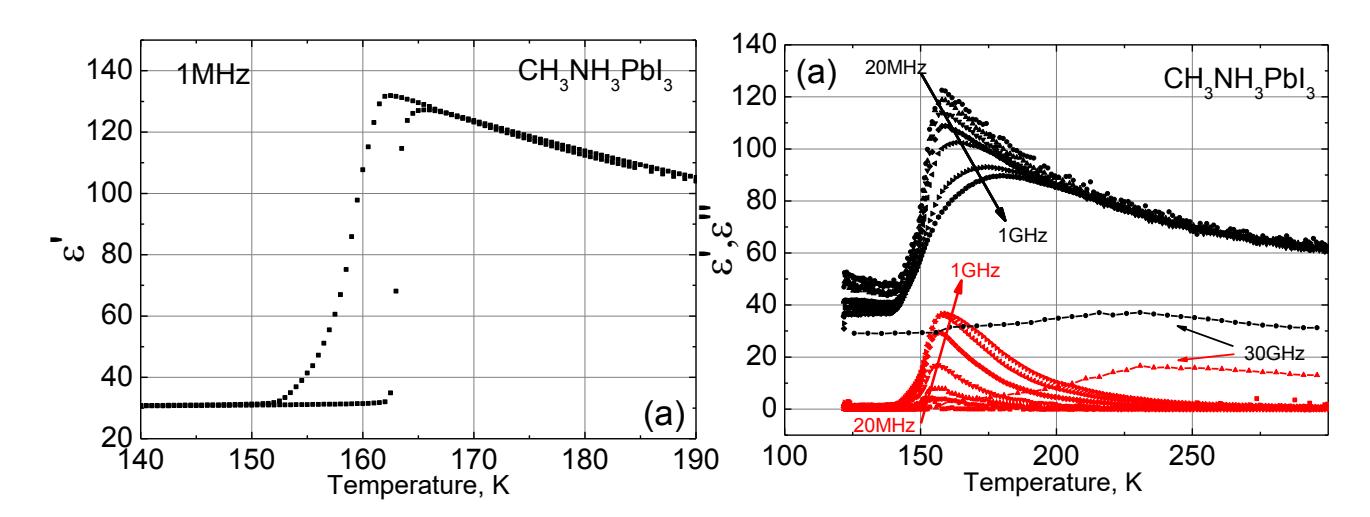
In this presentation dielectric properties of organic-inorganic lead halide perovskites will be presented. The first order phase transition (from tetragonal to orthorhombic phase [4]) was observed in all three halide perovskite crystals at temperatures around 160K, 150K and 175K for X=I, Br and Cl accordingly. The temperature hysteresis of the first order phase transition is around 5-7 K for all crystals (Fig 1. (a)). Furthermore the dispersion observed in figure 1 (b) suggest that CH3NH3PbX3 crystals have order – disorder phase transition.