
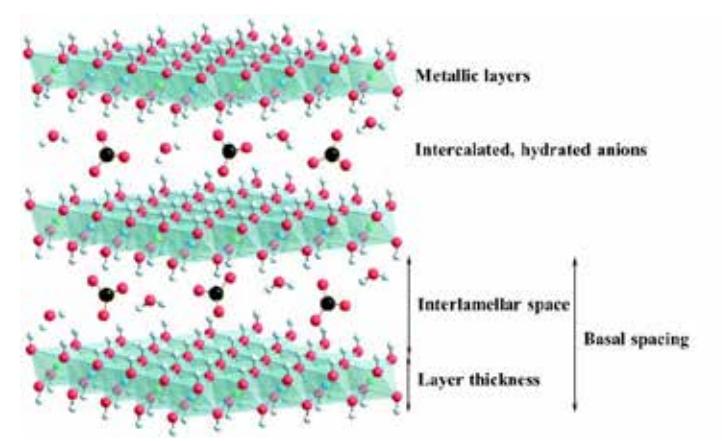
Layered double hydroxides (LDHs) are popular and well-studied materials in the field of inorganic chemistry, catalysis and materials science. [1] They have typical lamellar structure with positively charged layers compensated by the so-called intercalated anions situated in the interlamellar space coordinated by water molecules. The layers usually consist of divalent (MII) and trivalent (MIII) metal ions with a MII:MIII molar ratio between 6 to 1. What makes the layered double hydroxides so diverse is the great variety of the metal ions in the layers and the facile anion exchange process. [2-4] The size and orientation of the compensating anions are the main factors of basal spacing, which is the sum of the thickness of a layer and the interlayer space. The schematic structure of a layered double hydroxide is shown in Fig. 1.
One of the most interesting properties of LDHs is delamination; a process, in which we treat the material in (typically) organic liquids in a way that the regular structure collapses and a colloid system of the individual sheets is formed. However, these delaminated/exfoliated layered double hydroxides can be regenerated into their initial form with aqueous treatment. The uncovered potential of the above-mentioned restacking process is the simultaneous anion exchange as the layered structure is rebuilt. The extent of delamination can be measured with dynamic light scattering, a method, which describes the average radii of particles in a colloid system. Although, the diameter of an exfoliated particle is identical with the intact crystal, the thickness is reduced leading to higher velocity in the liquid system. Since the instrumental respond relies on the movement of the particles, thinner ones are interpreted as they have smaller average radius.
The main goals of our work were: (i) the characterization of the exfoliating ability of different types of organic materials towards magnesium-aluminum layered double hydroxide (MgAl-LDH), (ii) selecting the LDH colloids having the smallest average size and treat them with aqueous solution of various anions, (iii) analyzing the solid precipitate after the hydration, and investigating whether ion exchange and restacking can take place simultaneously.
Our study reveals that MgAl-LDH was successfully delaminated in polar amides, as formamide, N-methylformamide, N-methylacetamide and in long-chained normal alcohols. Usually, delamination was finalised by ultrasonic treatment. Since the amides are miscible with water, we started our restacking experiments with LDHs exfoliated in formamide. As rehydrating solutions, we applied numerous sodium salts with singly-, doubly- and triply charged anions. Recontruction was accomplished using anions with one and two negative charges, but triple-charged ones generally disrupted the rebuilding process, likely, because their salts with the metals of the LDH are very stable, and the thin layers can more readily transform to the salts rather than the ordered materials. The characterization of the samples were performed by several methods: X-ray diffractometry (XRD), infrared spectroscopy (IR), dynamic light scattering (DLS), scanning electron microscopy (SEM) and energy-dispersive spectrometry (EDS).