Upconversion nanoparticles (UCPNS) are a separate group of phosphors with a luminescence mechanism which is different from that of organic dyes and quantum dots [1]. The process consists of simultaneous emission of two or more photons and eventual emission of light in shorter wavelength than excitation wavelength [2]. Due to their potential for different applications varying from biological imaging to targeted drug delivery UCNS are a subject of a special interest in science. NaGdF4: Yb3+, Er3+ exhibits excellent upconversion fluorescence peaks in blue, green and red spectral areas under 980 nm IR laser excitation. Besides, as a Gd3+ -containing host, NaGdF4 can be characterized by superior magnetic properties, making it a promising hmaterial for simultaneous optical and magnetic imaging [3].
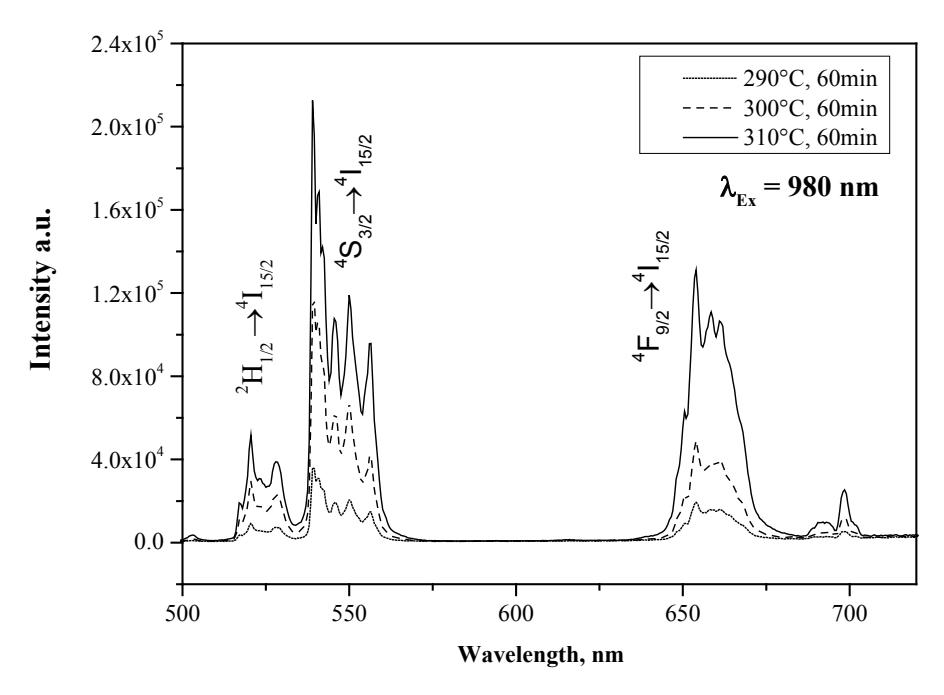
For most applications in biological systems it is essential to produce the compounds with controllable size and narrow size distribution. It has been noted that synthesis conditions have a great influence on the physical properties of the final product [4]. The effects of reaction temperature and synthesis duration on the morphology and size were investigated. Luminescent properties of particles were determined by spectrofluorometer. Information about $\alpha$ and $\beta$ (desired) phase composition was obtained through X-ray diffraction analysis. Size and dispersion of UCNPS was examined using scanning electron microscope. The luminescence intensity dependence on reaction temperature is illustrated in figure 1.