
Various atomic and ionic characteristics of tungsten ions are of great concern being the subject of experiments and of numerical simulations. The data required involve mainly electron-ion collisions, and include excitation, recombination and ionization processes.
We have investigated electron-impact ionization cross sections from the threshold to 20000 eV for the ground configuration of the W25+ ion. The ground configuration of the W25+ ion ([Ni]4s24p64d104f3) consists of 41 levels. Main attention has been focused on influence of the increasing principal and orbital momentum quantum numbers to the excitation-autoionization (EA) process and its contribution to full ionization cross sections. The calculations were carried out using the Flexible Atomic Code (FAC) [1], which employs Dirac-Fock-Slater method. The subconfiguration-average and level-to-level distorted-wave (LLDW) approximations are utilized to describe the electron excitation and ionization processes.
The total electron-impact single-ionization cross sections from the level i of Aq+ ion to the level j of A(q+1)+ ion can expressed by direct and indirect processes as following:
$$\sigma_{ij}(\varepsilon) = \sigma_{ij}^{\text{DI}}(\varepsilon) + \sum_{k} \sigma_{ik}^{\text{exc}}(\varepsilon) B_{kj}, \tag{1}$$where $\sigma_{ij}^{\text{DI}}(\varepsilon)$ is the direct ionization (DI) cross section at the electron energy $\varepsilon$, $\sigma_{ik}^{\text{exc}}$ is the electron-impact excitation cross section to the level k of the Aq+ ion, Bkj is autoionization branching ratio. The study includes excitations up to the shells with the principal quantum numbers $n \le 25$ and orbital quantum numbers $l \le 6$. All possible electric dipole and Auger transitions from the generated excited configurations are calculated.
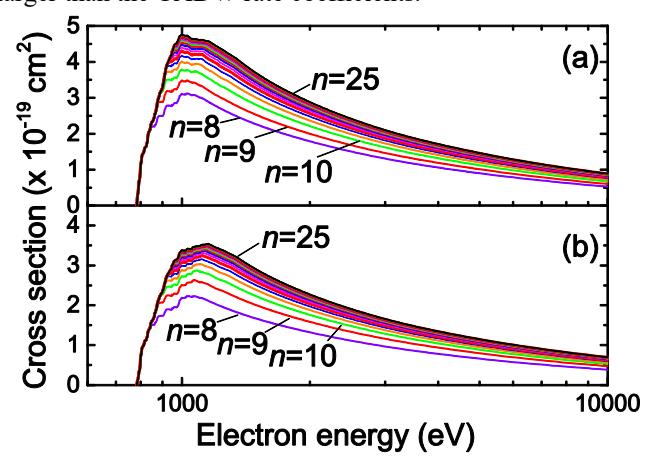
Figure 1 shows that excitations to the high-nl shells ($9 \le n \le 25$) increase electron-impact cross sections of indirect ionization process by about a factor of 2 compared to the excitations to the lower shells ($n \le 8$). This conclusion is in agreement with recent works [2, 3]. Current results demonstrate that the contribution of the EA channels originating from the excitations to the high-nl shells has to be estimated in the analysis of the electron-impact ionization process for the highly charged ions. In order to estimate the contributions from the high-nl shells, the convergence of the cross sections of the EA process must be checked. Furthermore, the obtained results demonstrate that the radiative damping has a large impact on the ionization cross sections. Also, it is established that the greatest contribution to the EA gives the excitations to the shells with the orbital quantum number $l = 4$. The EA channel for the excitations from the 4d shell is predicted to show the largest contribution for the LLDW results with $n > 8$ compared to the EA channels from 4p but in the case $n \le 8$. This can be explained by the fact that large amount of configurations produced by excitations from the 4d shell are below the ionization threshold.
Maxwellian rate coefficients derived from our calculated cross sections for the ground state are compared with the previous values obtained using configuration-average distorted-wave (CADW) rate coefficients. The rate coefficients for DI cross section are smaller than CADW rates while EA rate coefficients are larger than CADW rates. The total DI+EA rate coefficients are about 16% larger than the CADW rate coefficients.