
Nitrogen-vacancy (NV) centers are powerful instruments in many areas of reasearch, including quantum information, magnetometry and nanoscale sensing. They have been used to detect individual electron spins and spin ensembles, measure the magnetic field distributions in biological signals and measure temperature and electric fields [1]. However successful use of NV centers demands understanding of the interactions between these centers and the environment.
This motivates recent efforts of the longitudinal relaxation time (also known as T1 relaxation time). It characterizes the population relaxation from a polarized state back to thermal equilibrium. Previous work has shown that T1 depends on the NV concentration [2] which means that not only phonons but cross-relaxation between NV centers play a role in the process.
In this work we examined the T1 dependence on the NV concentration as well as applied magnetic field for NV centers prepared by electron irradiation with varying dosage. A stretched exponential $e^{-(\left(\frac{t}{\tau_1}\right)^{\beta})}$ is used to describe the data in order to account for a wide range of relaxation processes and the obtained $\tau_1$ and $\beta$ parameters are plotted as a function of NV concentration (figure 1). Strain splitting and zero field splitting were also measured for different NV concentrations as well.
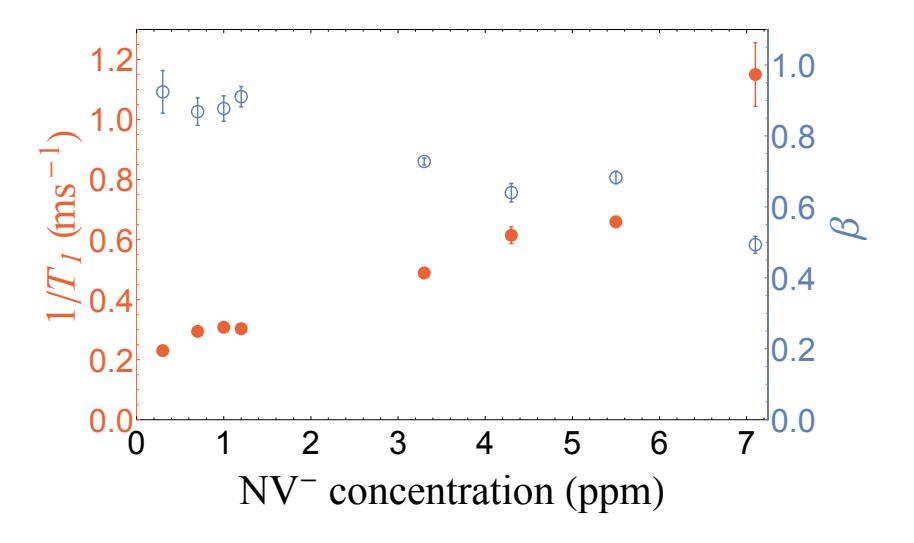
The main conclusions obtained in this work are that with higher concentrations of NV centers the relaxation becomes more "stretched" which means that there are more relaxation channels than at lower concentrations. Also the T1 time decreased with increasing NV concentration and could be used as a proxy (among other parameters such as luminosity) for determining NV concentration. We also observed a correlation between strain splitting E and NV concentration but no change in zero field splitting D which means that the N-V distance does not change with increasing defect concentration.