
Imaging with waves of the range between 100 Ghz to 3THz is a very promising field of development of the present photonics. It is so because of no-ionizing THz radiation nature and unique spectral fingerprints that have a number of dangerous substances in this range [1]. In order to achieve fast and accurate imaging in the THz range intensive efforts are undergoing to create efficient THz cameras.
Currently, many factors are causing problems in creating an efficient active imaging system. Commercially available sources of THz radiation have relatively low power. Radiation beam is further attenuated by the water vapor present in the atmosphere. Adding the poor performance of existing uncooled detectors that are sensitive to radiation in THz range, a very low system performance is obtained.
Therefore there is need of sophisticated optical elements that would increase an efficiency of such imaging system. To achieve this goal we introduced a matrix of lenses. Each component is associated to a single detector and has large aperture, low absorption and Fresnel reflections as well as high focusing efficiency. The structure must be thin, lightweight and cost-effective in production to be in the future aplicable in real devices hence we choosen the diffractive structures. To get very good performance designed structures were printed on a 3D printer [2] using PA12 material.[3]
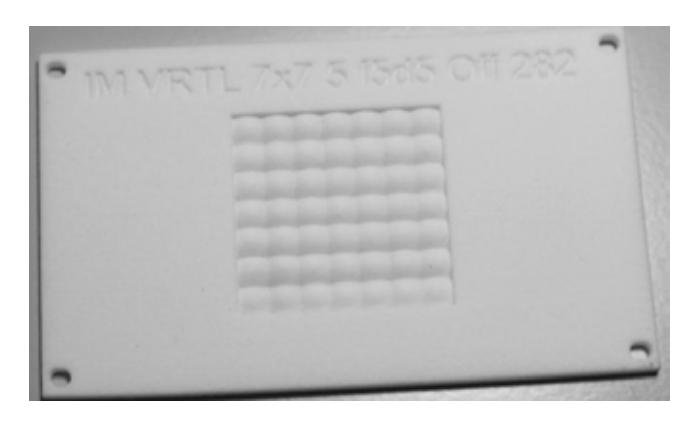
The response of the detectors were measured and compared with and without the matrix of lenses. The performance was improved approximately 6 times in the case of matrix from Fig. 1.