
β-Diketones represent one of the oldest classes of versatile chelating ligands forming very stable chelate complexes with various metal ions.[1] One of the best-known compound which belongs to this group is acetylacetone. However, due to bad solubility in water and good solubility in organic solvents, acetylacetonate metal organic complexes are difficult to recover from the organic solution by water wash method. Additionally, these complexes are usually thermally unstable because of their low decomposition temperatures.[2] These problems could be solved by anchoring of acetylacetone ligands/complexes on a solid phase. In this presentation immobilisation of acetylacetone derivatives on surface of superparamagnetic iron oxide nanoparticles will be presented.
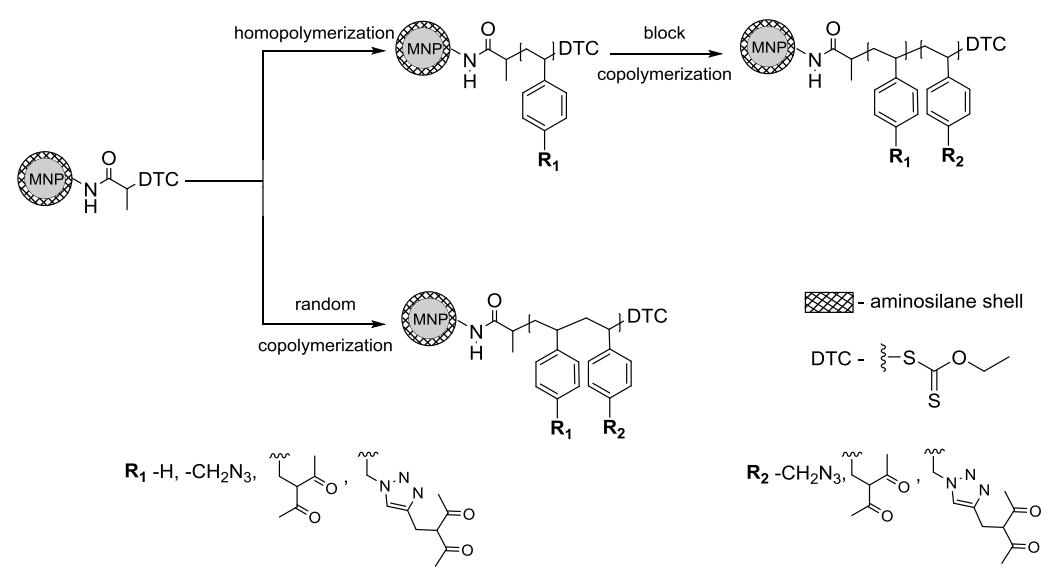
Three different chelating monomers (two of them possess acetylacetone moiety) were synthesized and used to form polymeric shells around magnetic cores by RAFT/MADIX (Reversible Addition-Fragmentation Chain Transfer and Macromolecular Design via the Interchange of Xanthates) polymerization. Two methods of synthesis of new bifunctional polymeric nanohybrids were applied. These nanohybrids consist of magnetic cores and polymeric shells which are covalently bonded to the surface. Therefore, they are very stable and resistant to washing off. In addition, these polymeric shells possess chelating properties. Also the influence of post-modification of polymeric shell on its properties were investigated. To investigate relation between polymeric shell structure and its chelating activity three types of polymerization were performed on surface of magnetic nanoparticles (MNP): hompolymerization, block copolymerization and random copolymerization (Fig. 1).[3]
Nanohybrides were fully characterized using variety of methods eg. FTIR, TEM, SEM/EDX, TGA, and fluorimetry.