
Today, LIDARs are used for mapping the 3-D structure of Earth's from space [1]. The use of the laser in space at an altitude of 500 km has strict requirements for output power and beam quality. The aim of this study were the simulation of the profile of the absorption of the pump energy by diode one-side pumping in a cylindrical active element as well as the calculation of the quality of the laser beam taking into account thermo-optical effects for further experimental assembly.
The pump absorption profile was obtained using software Optichamber 2. There was a trade-off between efficiency and uniformity of the pumping profile. For a more uniform pumping profile is known to use non-cylindrical reflectors [2,3]. During the study of the absorption profile of the pump have been identified some trends in the choice of reflector for a more uniform beam.
For multiple configurations of the quantrons the total optical pumping efficiency reaches more than 65% at a satisfactory beam quality (see Fig.1) the uniformity of absorbtion profile increases if we use diffuse cavity reflector and wide placed diode bars.
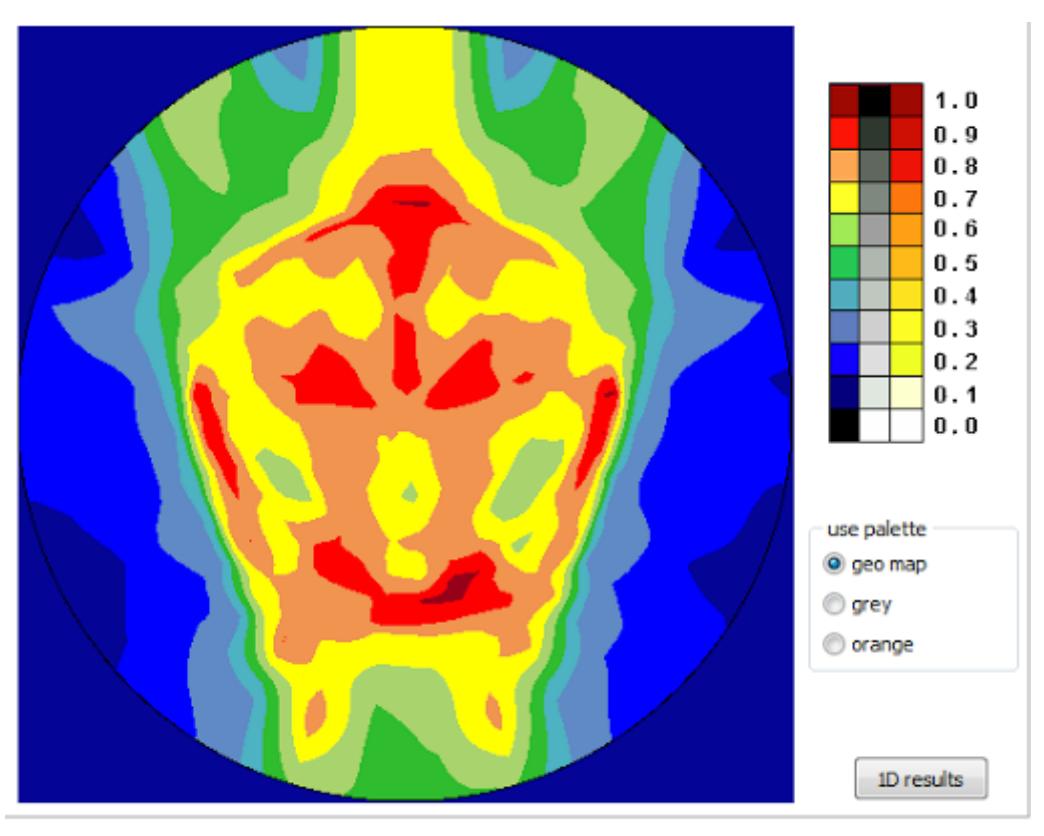
The beam parameters were calculated using Matrix Formalism and ABCD law. Effect of heating the rod, leading to a change in the refractive index in the parabolic approximation, is reduced to take into account the positive thin lens in cavity.