
The interest in semiconductor materials has been growing in the last decades and had a strong impact on the development of variety of electronic devices and modern technologies. The integration and utilisation of organic materials in technology has begun relatively recently. These materials have been used in different specific areas as well as various devices, such as metal detectors, OLEDs, OTFTs, organic solar cells. Naphthalimide derivatives are well known as an anticancer agent and are used for fluorescence sensors and are easily modified. This scientific study covers the topic of spectroscopic properties of naphthalimide derivatives (Fig. 1), modified with a different mass thiophene and alkylthiophene substitutes (Fig. 2), as well as control of optical characteristics in a different polarity and viscosity mediums.
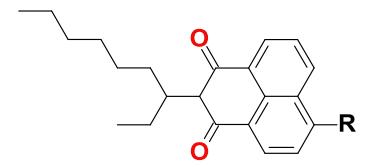
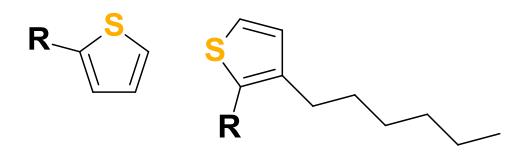
Two materials with different torsion effect have been chosen for this investigation. The torsion angle of thiophene substituent was controlled by introducing an alkyl chain in the 4th position. Both structures demonstrate local and charge transfer states in absorption and emission spectra. The emission of naphthalimide derivatives exhibits strong solvatochromic behaviour by increasing the polarity in medium from toluene (non – polar medium) to DMSO (polar medium). 1,8 – naphthalimide – thiophene compound demonstrates a typical red shift in the fluorescence spectra. Meanwhile, alkyl chain modifies torsion effect of thiophene substituent which affects the dynamics of charge transfer states and emission spectra. Dependence on solvent polarity and naphthalimide substituent massiveness showed that molecular twist is very important in optimizing the fluorescence quantum yield. It has been shown that photochemical reactions and the control of non-radiative relaxation speed is very strongly influenced by the molecular fragment twist. Naphthalimide with thiophene substituent has shown an increase of fluorescence quantum yield up to 6 times (from 10% to 60%) while the polarity of medium was increased. However naphthalimide with alkylthiophene substituent has shown a decreasing fluorescence quantum yield up to 12 times (from 6% to 0,5%).
In order to distinguish the influence of medium polarity and viscosity to optical properties of 1,8 – naphthalimide – thiophene derivatives were dissolved in four solvents increasing viscosity and constant polarity. Although both compounds show local and charge transfer states in absorption and emission spectra, the solvatochromic behaviour is insignificant. Moreover, naphthalimide with thiophene substituent shows minor changes in fluorescence quantum yield from 70% to 63% while alkylthiophene substituent slightly increases fluorescence quantum yield from 5,5% to 7,2%, on the condition that the viscosity of the medium was increased. That nontrivial effect is related to the competition between radiative and non radiative relaxation channel while the nature of charge transfer is changing. Radiative relaxation was very fast (2ns), for naphthalimide with lover mass thiophene substitute in comparison to the naphthalimide with higher mass alkylthiophene substitute (50ns) independent to the viscosity of the medium. However, polarity increase slows radiative relaxation process for naphthalimide with alkylthiophene substituent up to 2 times (from 30ns to 65ns).
1,8 – naphthalimide derivatives with thiophene substituents are promising materials for sensor technologies, due to their high sensitivity to the medium polarity up to 12 times.