
This study describes the formation of effective reflection holograms in the glassy layers of polymethylmethacrylate (PMMA) with a high content of phenanthrenequinone (PQ).
Holograms were recorded using Denisyuk scheme (Fig. 1). A semiconductor laser with a wavelength of 532 nm was used in experiments, light beam was expanded and passed through the diaphragm to control its size.
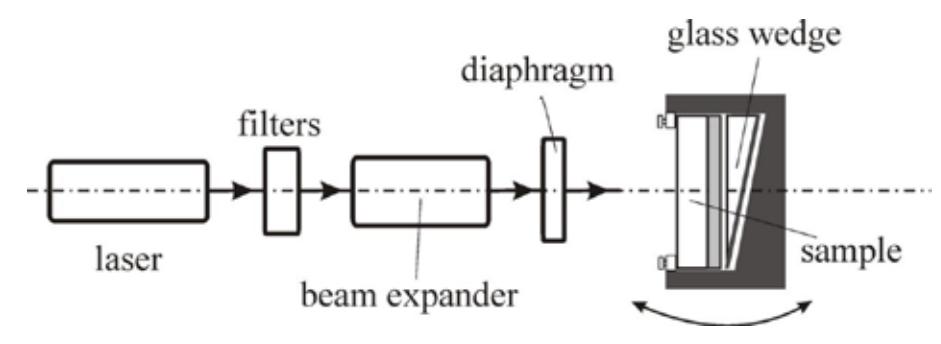
The recording gratings were probed by laser radiation at $\lambda$=532 nm and the measurements of the diffracted beams intensities were performed. The diffraction efficiency ($\eta$) was determined as the ratio of the diffracted beam intensity to the intensity of the probing beam.
Upon laser radiation photosensitive PQ molecules attach to macromolecules. Under the influence of a sinusoidally modulated field of interfering beams an antiphase spatial distribution of concentrations of PQ and its photoproduct is formed [1]. Since the refractivities of PQ and photoproduct differ slightly, the hologram with a diffraction efficiency of 6% was achieved at the recording process. Further in the process of the dark relaxation at room temperature (18°C), $\eta$ increased up to 18%. Despite the low temperature, there was a diffusion of PQ molecules, whereas being attached to polymer matrix molecules of photoproduct remain fixed. Diffusion leads to spatial alignment of PQ concentration in the layer and consequently to a degradation of PQ contribution to the refractive index distribution, and the hologram efficiency increases.
Diffusion of PQ molecules obviously intensifies at elevated temperatures [2]. It has been experimentally revealed that the sample annealing at a temperature of 80 °C results in almost fourfold increase of hologram diffraction efficiency. To fix hologram after annealing it is enough to perform uniform light irradiation and the diffraction efficiency is revealed not to decrease in the process.
Analysis of the recorded gratings also included measurement of contour of angular selectivity (the dependence of the diffraction efficiency on the angle of incidence of probing beam). The angular selectivity value was calculated as a full width at half maximum of the contour:
We have also recorded gratings under the scheme in Fig. 1 for different incidence angles of probing beam, the same value of n is achieved, but the angular selectivity is changing – see Table 1.
| angle of incidence | angular selectivity |
|---|---|
| 0° | ≈2° |
| 8° | 1° |
| 16° | 36′ |
The results received indicate to possibility to use holographic materials investigated for multiplexing recording.