ITER – Like Wall project has been launched at Joint European Torus to test plasma facing materials relevant to International Thermonuclear Experimental Reactor – ITER. Beryllium will be used as plasma facing material for first wall and neutron multiplier in blanket zone. This material was selected due to low Z, good thermal conductivity and high oxygen gettering characteristic.[1]
Erosion and tritium accumulation are the main issues related to performance of the plasma facing materials in the vacuum vessel of fusion reactors. Thermal transiet loads cause heating of beryllium surface and can result in significant changes – material loss, melting, cracking evaporation, formation of dust and hydrogen isotopes retention in the wall materials and dust.[2,3]
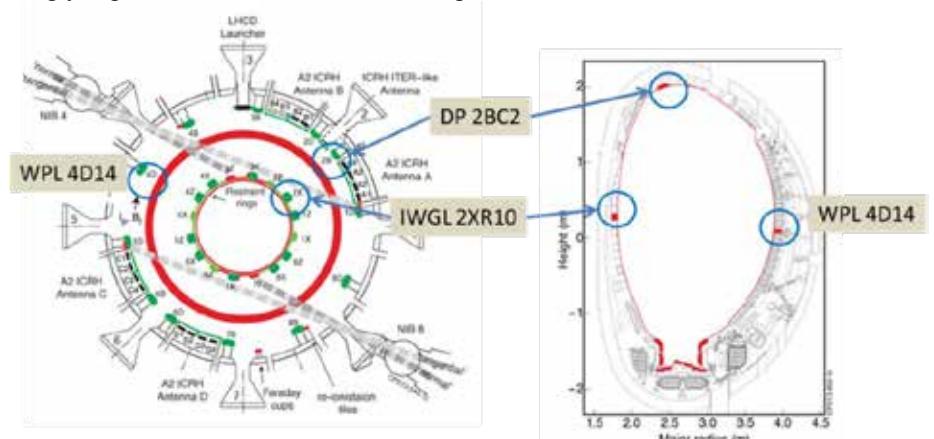
During the shut down in 2012, beryllium tiles were removed from three positions in the vacuum vesel. Tiles were from the iner wall (Inner Wall Guard Limiter), outer wall (Wide Poloidal Limiter) and upper region (Upper Dump Plate) (Fig.1).
To assess changes in the surface, beryllium tiles were studied with scanning electron microscopy and energy dispersive X-ray spectroscopy. A beryllium dissolution method under controlled conditions was used to determine tritium concentration and its bulk distribution in the sample. During dissolution tritium and hydrogen was released (1) and both measured.
$$Be(s) + 2H^{+}(l.) \rightarrow Be^{2+}(l.)+ H_{2}\uparrow(g)\tag{1}$$Results revealed that tritium was localized in 80 μm of the tile surface with highest concentration in the first 2-10 μm. SEM and EDX analysis demonstrated that surface structure modifications and chemical composition of the deposited layer strongly depends on the location of the sample in the vacuum vessel.