
Optical and mechanical characterization is important in fabrication of optical components which are widely used in laser systems. Optical properties of materials are essential in modeling sophisticated elements which could be suited in various applications. In production of such elements many layers of different materials with high and low refractive indexes must be deposited on substrates. During coating processes inner stresses emerge in films due to defects, lattice mismatch, difference between the thermal expansion coefficients of substrate and thin layer and etc. Stresses can cause cracking, peeling off or substrate bending, so the possibility to handle inner stress is crucial in production of high quality optical elements.
In present work we report the applications of plasma source assistance in electron beam evaporation technique and its influence on optical and mechanical characteristics of materials with high refractive index - Nb2O5 and Ta2O5. Layers with three quarters optical thickness of each material were evaporated using optical monitoring control at 630 nm wavelength. Twelve different evaporation processes were accomplished by using different plasma source parameters. The power of plasma source was 1000 W and 2000 W, the energy of generated oxygen ions was varying approximately from 100 eV to 170 eV. All processes were started at 110 °C and in high vacuum of $p_0 = 1.0 \cdot 10^{-5}$ mbar. An oxygen flow was controlled during the process to maintain the pressure in chamber at $1.5 \cdot 10^{-4}$ mbar. The evaporation rate was 2 Å/s for both materials and controlled by crystal quartz monitoring.
The refractive indexes of Nb2O5 and Ta2O5 thin films were determined by modeling transmission spectra using "OptiLayer" program. The stresses in the films were calculated using Stoney formula, which evaluated the curvature of the 1 mm thickness fused silica substrate before and after material evaporation on it [1]. Profilometer and interferometer for determination of curvatures were employed.
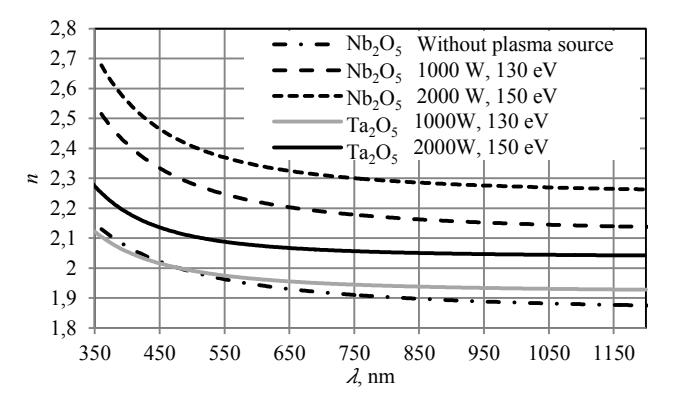
The dispersions of characterized refractive indexes are represented in Fig. 1. If the plasma source is not used during electron beam evaporation, the refractive index of Nb2O5 is comparatively small – 2.0 for 500 nm wavelength. When the assisted plasma source is employed the refractive index can be raised due to the plasma generated ions which affect the material atoms to form denser layer. The values of 2.4 and 2.1 for 500 nm wavelength of Nb2O5 and Ta2O5 thin films respectively can be accomplished by optimizing the parameters of plasma source.
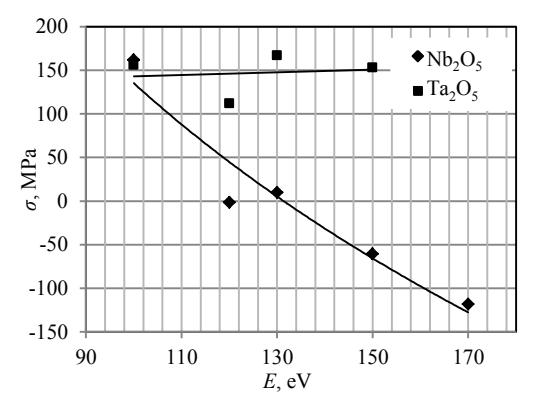
The inner stress in Nb2O5 thin film was changing uniformly from compressive to tensile when assisted plasma source was used during electron beam evaporation. Only compressive stress values were observed for Ta2O5 coatings. The stress dependency on ions energy is shown in Fig. 2. This relationship gives a possibility to manufacture good quality Nb2O5 multilayer optical elements with flat surface which makes no distortions for interacting wave front.