
A basis of harmonic-oscillator functions is extremely useful and efficient in describing compact quantum systems, such as nucleons. The traditional applications, such as the nuclear shell model, are based on model Hamiltonian with individual one-particle variables. As a result, the corresponding model wave functions are not translational invariant and such model system is not properly represented because of center of mass (c.m.) motion[1]. One of the possible solutions for c.m. motion elimination is based on direct construction of the many-fermion wave function, which is independent from c.m. coordinate[2]. In this case, the harmonic-oscillator basis set in terms of intrinsic (Jacobi) coordinates is necessary. The set of HO functions can be chosen in a such manner than the transformation from one set of Jacobi coordinates to another results in expansion with a finite number of terms. This approach requires the Talmi-Moshinsky transformation[3, 4] and corresponding brackets.
In ab-initio many body system calculation it is useful to use coupled cluster models. The $N$ identical particle system could be divided in two subclusters with $N_1$ and $N_2 = N - N_1$ particles respectively. If the each subcluster has its own intrinsic antisymmetrization the two body transposition operator $P_{N_1N}$ is useful to secure the antisymmetry of the whole system[5]. This operator transforms Jacobian coordinates depending on clusterization and the initial antisymetrization of $N$ particle system.
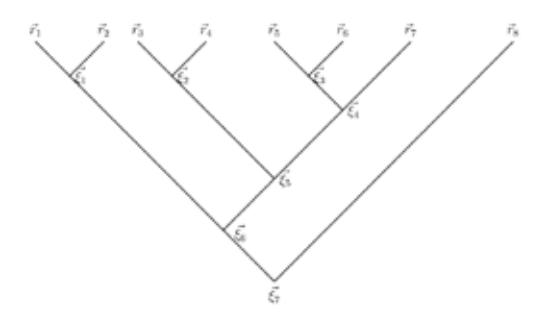
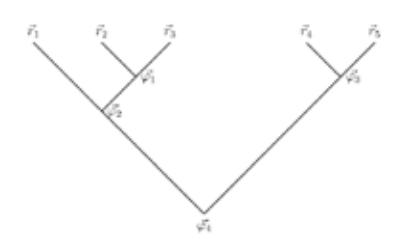
We present an independent scheme of transformations suitable for the $N$ particle system consisting of subsystems composed of $N-1$ and $1$ (Fig.1) or $N-2$ and $2$ (Fig.2) particles, where the subsystems have intrinsic clusterization. Expressions for corresponding harmonic oscillator transformation brackets for five particles (5HOB) are presented and the examples of few body fermion systems where 5HOB can be applied are shown.