Femtosecond filamentation is a phenomenon arising from the nonlinear interaction between the intense ultrashort laser pulse and transparent dielectric medium, which modifies the spatial, temporal and spectral properties of the incident radiation and induces temporary or permanent modification of the optical properties of the medium itself [1]. A particularly interesting regime of filamentation occurs in solid-state dielectric media with anomalous group velocity dispersion (GVD), where the input wave packet undergoes space-time focusing leading to generation of self-compressed spatiotemporal light bullets [2] and ultrabroadband, several octave-spanning supercontinuum (SC) [3]. However, so far filamentation phenomena were almost exclusively studied in isotropic materials, where the nonlinear effects arise from the intrinsic cubic (Kerr) nonlinearity, therefore limiting control over the filamentation dynamics. On the other hand, it is well known that phase mismatched second-harmonic generation (SHG) in anisotropic crystals possessing quadratic nonlinearity leads to recurrent energy exchange (cascading) that imprints large nonlinear phase shifts on the interacting waves [4]. The cascading effect produces an effective nonlinear index of refraction, which can readily be controlled by setting an appropriate phase mismatch between the interacting waves.
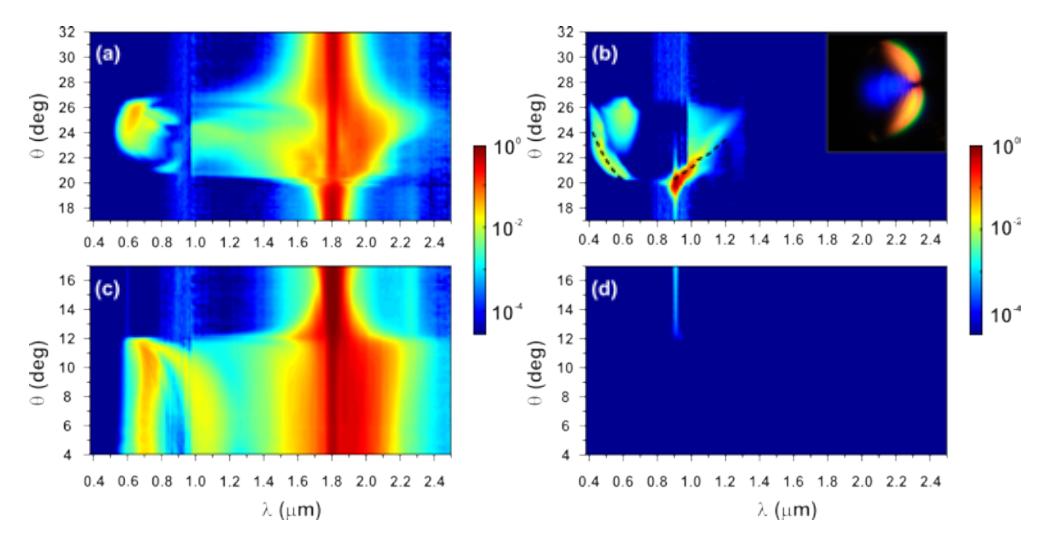
In this work we demonstrated that competing cascaded-quadratic and intrinsic cubic nonlinear responses may be used for control of filamentation and supercontinuum generation dynamics in a birefringent nonlinear medium with anomalous GVD (see Fig. 1). The experiments were performed using 90 fs, 1.8 μm wavelength pulses in a $β$-BBO crystal cut for type-I SHG within a broad range of positive and negative phase mismatch parameters, which were varied by simply changing the angle $θ$ between the incident wave and the optical axis of the crystal. In particular, we found that in the case of large negative phase mismatch, the filamentation threshold is markedly reduced due to the enhancement of the effective nonlinear refractive index, leading to SC generation at sub-critical powers for self-focusing. In contrast, positive phase mismatch yields strong negative cascaded nonlinearity which competes with the intrinsic one, resulting in a lower effective nonlinear refractive index and SC generation at elevated intensities. By the use of three-dimensional imaging, we verified that in both cases the SC generation is facilitated by three-dimensional self-focusing of the input pulses, which transform into the self-compressed spatiotemporal light bullets with more than four-fold compression factors. Giant spectral shifts of the second harmonic radiation observed in the region of negative phase mismatch were attributed to a light bullet-induced second harmonic self-phase matching condition.