Lasers operating in the wavelength range above 2μm have many applications: contactless highly sensitive gas sensors, biosensing, medical sensing and medical devices, etc. A novel approach to cover this wavelength range is InP-based lasers [1]. These utilize the type-II band alignment between GaInAs and GaAsSb, to create transition energies below the band gap of the constituent materials [1].
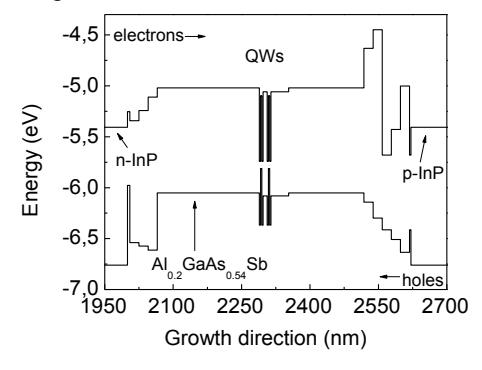
The lasers are based on n-InP substrate with active region and cladding layers grown on top. The structures were grown with Molecular Beam Epitaxy (MBE). The active region consists of quantum wells with W-shaped based structure. These are made of two 2.6 nm thick layers of Ga0.32In0.68As surrounding a 2.9 nm thick GaAs0.3Sb0.7 layer. The active region consist of different number W-shaped QW. The band structure is depicted in Fig. 2.
Thermal properties of laser devices are very important for later applications, since they are required to provide lasing at room temperature or at higher temperatures. The main loss mechanisms in semiconductor lasers are non-radiative recombination mechanism, free carrier absorption and interband absorption. Those three are strongly depend on temperature. Since most of the input power below laser threshold is lost due to radiative recombination, one of the most important characteristics of a laser is the threshold current desnity.
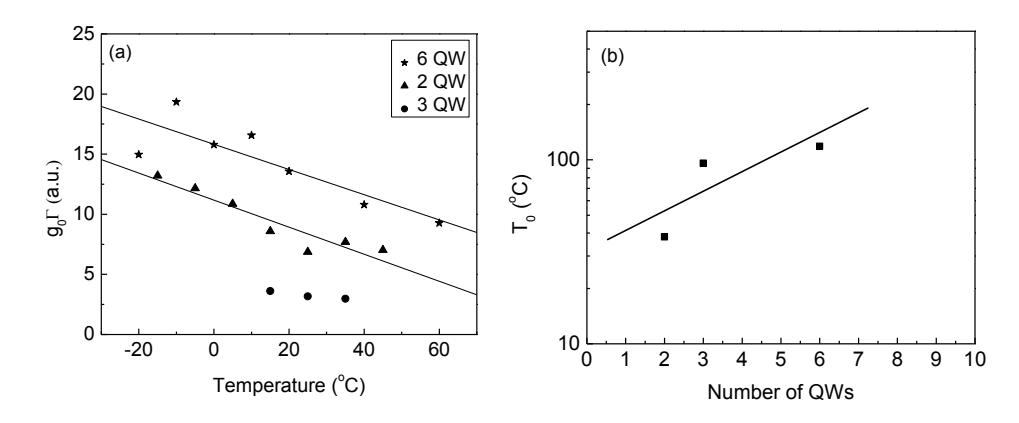
Fig. 1. shows dependence of threshold current density plotted against temperature. The optical output was measured by an liquid nitrogen cooled InSb. For increasing temperature, loss mechanisms get stronger and are causing higher threshold currents. Such behavior was also reported for GaSb-based lasers and could indicate different loss mechanism, like a resonant absorption. [2]. As can be seen in Fig. 3(b) the characteristic temperature of the laser is strongly increasing with higher numbers of QWs. The temperature dependence of the modal gain $\Gamma g_0$ however seems to be independent of the number of QWs (Fig. 3(a)).
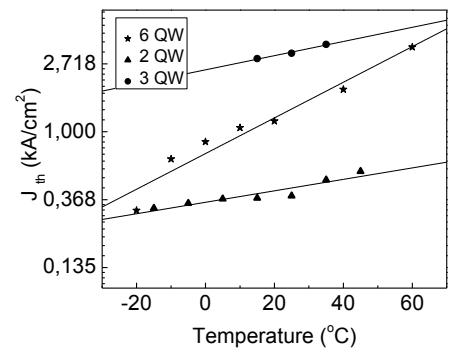
Therefore, higher number of QWs offer a higher thermal stability, due to lower filling of the QWs, the total threshold current densities, however, are still lowest for small number of QWs.