The recent updates to the International Technology Roadmap for Semiconductors (ITRS) [1] set out the need for fundamentally new technologies to replace existing silicon-based device components. One attractive solution is to develop molecular-scale analogues of key components such as wires, diodes and transistors. For the present, the challenge is to understand the chemistry and physics that controls current flow through molecules. Only then this knowledge is in place can real progress be made in addressing issues related to incorporation of such components into realistic devices.
Much of the recent momentum in the field of molecular electronics has been centred on organic components, where the $\pi$ conjugated systems typically provide the dominant transport pathways. Transition metal based systems, in contrast, have been somewhat overlooked despite the fact that their innately flexible electronic structure offers enormous potential. Ligand field effects, changes in redox and spin state and metal-metal bonding all play a critical role in determining the nature of the transport channels near the Fermi level in a putative molecular electronic device. Structure-function relationships – principles that can guide synthetic effort towards target molecules – are not as well developed in the context of transition metal electronics as they are in the organic field.
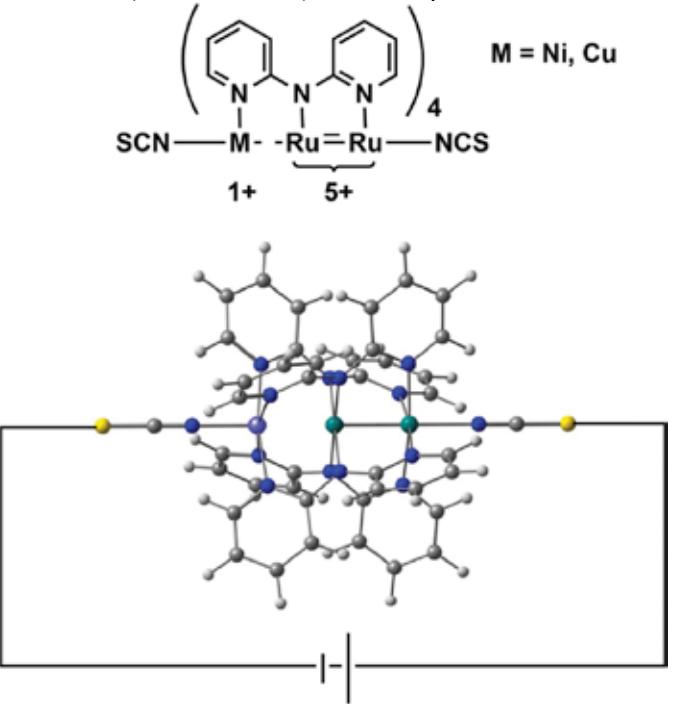
The design of rectifiers, compounds which function is to allow the preferential flow of current in one directions, has been a holy grail since Aviram and Ratner first proposed the concept 40 years ago [2]. It is clear that asymmetry, either in the molecule or in its contacts to the electrodes, precludes the possibility that current flow is rigorously symmetric, but to what extent does the compositional asymmetry actually perturb the transport channels of interest? Arrays of redox-active transition metals are a promising avenue for further study: intramolecular electron transfer can support large internal electric fields which localize channels on one side or other of the molecule. Subtle changes in the left-right delocalization of a channel can then be controlled through spin-polarisation, and this can lead to substantial rectification ratios. In this presentation I will present our computational work [3] that seeks to provide a set of guidelines for electronic structure-function (viz rectification) relationships in transition metal atom chains (see Fig. 1).