
Acetylacetone (AcAc) is a relatively simple organic compound whose structure is determined by an internal hydrogen bond. This molecule has been analyzed before but not all of its structural and dynamic properties have been fully researched [1]. In this experiment, acetylacetone molecules formed intermolecular hydrogen bonds with water molecules. Analysis of such complexes is a good way to study the influence of hydrogen bond formation on properties such as complex structure, charge and energy transfer mechanisms.
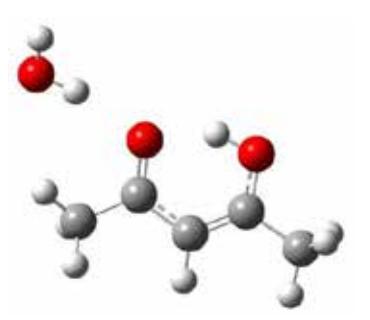
Theoretical calculations (using density functional theory (DFT) at the B3LYP/6-311++G(3df,3dp) level) gave information about the possible molecular complex geometry (fig. 1) and the theoretical IR spectra.
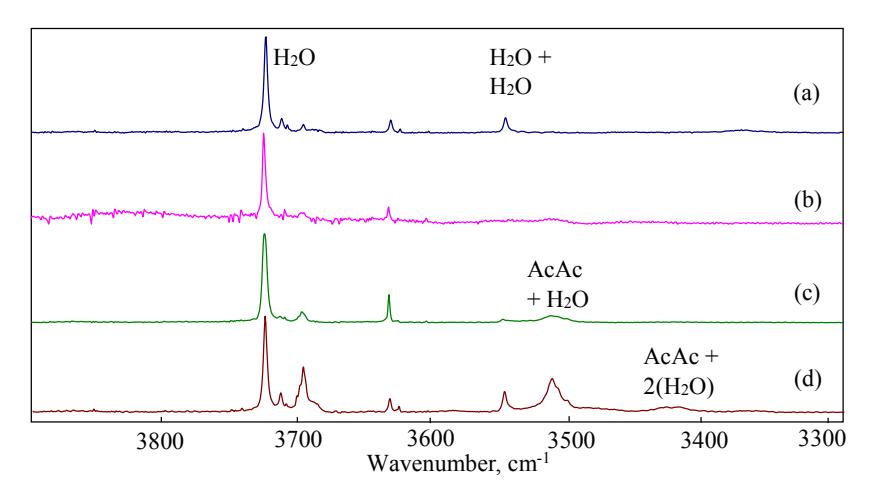
IR spectra were registered after isolating sample molecules in a host gas and depositing them on a low-temperature spectral window. We registered the spectra of both pure substances and their mixture. From the new bands in the mixture spectra (fig. 2) at 3520 cm-1 and 3420 cm-1 we can conclude that stable complexes do form from one acetylacetone and one or two water molecules. Acetylacetone bands themselves are not very sensitive to the formation of hydrogen bond. The greatest changes can be witnessed at 960 cm-1 (band resulting from the out-of-plane bending vibration of OH).
The obtained results were enough to determine that the water molecule is attached to the carbonyl group in acetylacetone. We also carried out experiments with argon as matrix gas and with deuterated acetylacetone and heavy water to better understand the dynamics of this complex.