HALOGEN BOND, HYDROGEN BOND – NONCOVALENT INTERACTIONS IN THE Cl-, Br-COMPLEXES
Aneta Lutyńska1, Małgorzata Domagała1, Marcin Palusiak1
1 Department of Theoretical and Structural Chemistry, Faculty of Chemistry, University of Lodz
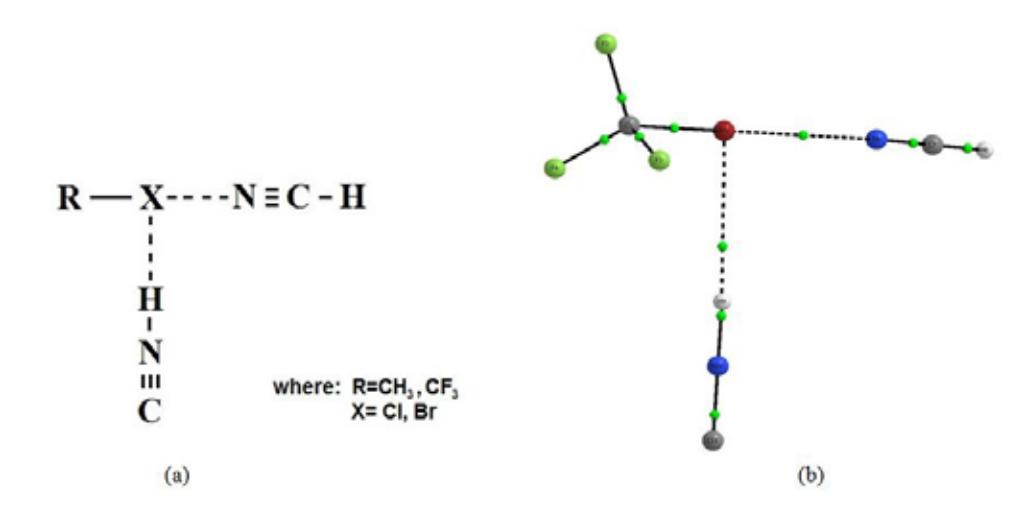
Since last a few years the halogen bond (X-bond) became one of the most thoroughly investigated noncovalent interaction [1,2]. This type of interaction is acting between the electron-acceptor fragment (Lewis acid) and electron-donor fragment (Lewis base). The cooperativity between H-bond and X-bond can be expected in systems shown in Figure 1. We analized complexes (RX)(HNC)(NCH), where R=CH3, CF3 and X=Cl, Br are schematically illustrated in Figure 1. The complexes of molecules are stabilized by two different noncovalent interactions, which can be classified as halogen bond and hydrogen bond.
The geometries of studied systems were optimized at $\omega$B97XD/aug-cc-pVTZ using the Gaussian 09 program [3]. The energetic and structural properties of all complexes were tested against the topological parameters of the electron density distribution obtained by means of a Quantum Theory of "Atoms in Molecules" (QTAIM) [4]. Finally, we establish the influence of CP-corrected optimization the geometries and interaction energies of the trimmers. If the X=Cl or X=Br will be called Cl-complex and Br-complex, respectively. The CP procedure was also taken into account during optimization [5,6], which means that the resulting geometry may be different from that obtained by the standard optimization.
Fig. 1. Spatial arrangement of interacting fragments (monomers) in complexes (trimmers) of halogen atom (a). The Br-complex is shown as an example (b). In the case of the Cl-complex the spatial arrangement was practically the same.
[1] P. Politzer, J.S. Murray, T. Clark, Halogen bonding: an electrostatically-driven highly directional noncovalent interaction, Phys. Chem. Chem. Phys.12, 7748-7757 (2010).
[2] A.C. Legon, The halogen bond: an interim perspective, Phys. Chem. Chem. Phys.12, 7736-7747 (2010).
[4] R. F. W. Bader, Atoms in Molecules: A Quantum Theory, Oxford University Press: New York, (1990).
[5] S. Simon, M. Duran, J.J. Dannenberg, How does basis set superposition error change the potential surfaces for hydrogen-bonded dimers?, J Chem. Phys.105, 11024-11032 (1996).
[6] W.-Z. Wang, X.-M. Pu, W.-X. Zheng, N.-B. Wong, A.-M. Tian, On the importance of CP-corrected gradient optimization in the study of hydrogen bonded systems, Chin. J. Chem.21, 1586-1590 (2003).