
High intensity laser research is a topic of great interest in modern sciences. These laser sources have various scientific applications. One of the most interesting examples is high-harmonic generation in gases, which requires intensity of a beam to be around 1015W/cm2. To reach such intensity with a laser system, which has energy of 10mJ and generates pulses with duration around 10fs, it is necessary to have beam focused to a spot, which diameter is smaller than 100μm.
Precise focusing requires careful selection of optical elements to be used. Avoiding aberrations is crucial for having high beam quality. That brings to the goal of this work – to measure aberrations, which can be caused by spherical and parabolic mirrors of large aperture.
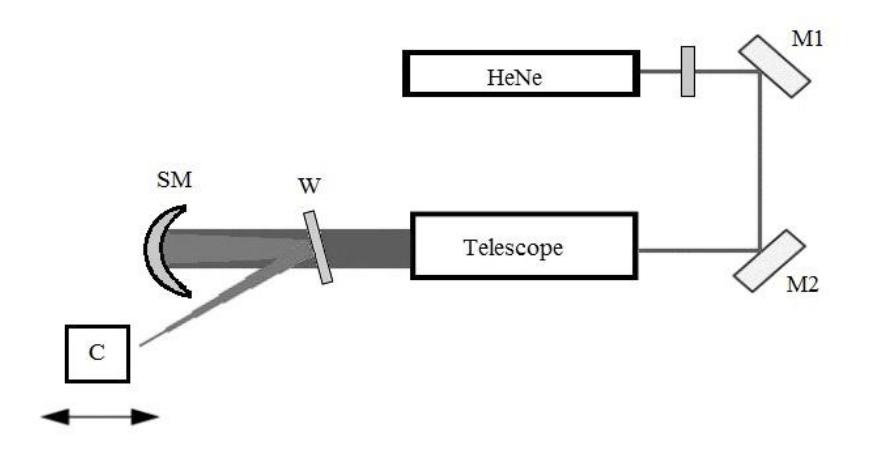
During the research, there was made an optical system (Fig. 1), generating 20-23mm diameter collimated beam. Experiments for measuring beam aberrations were carried out and it was found that beam experiences mild astigmatism. Furthermore, characteristics of the beam, reflected from 75mm diameter and R=3000mm spherical mirror were measured. It was found, that astigmatism in a system depends on a pressing and a position of the mirror. Position of least astigmatism was found.
Also, by varying angle of incidence, changes of focus spot size and astigmatism were observed. All measured values were compared with theoretical ones.
Investigation will be continued on parabolic mirrors.