
All visible colours for human can be described mathematically using colour mixing principles and human's eye characteristics. The eyes have three kinds of a cone cells if the vision is normal. These cone cells have different spectral sensitivities and according to that the colorimetric viewing functions were derived and standardized as CIE 1931 2° Standard Observer. Colorimetric viewing functions relate physical and physiological light parameters. Rods and cones are responsible for human vision and have uneven spatial distribution in retina, so colorimetric functions depend not only on spectral sensitivity of different cones, but also on spatial distribution of rods and cones, so our vision depends on viewing angles. For this reason for larger viewing fields CIE 1964 10° Standard Observer was derived.
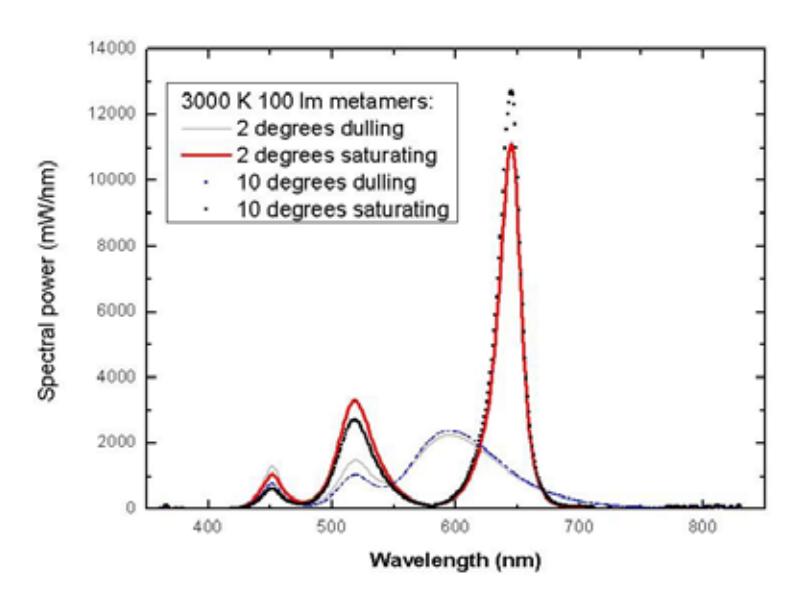
The main problem resulting from this colorimetric functions dependence on viewing angles is that it makes it more difficult to describe colours unambiguously. Nowadays almost every light and colours related institution uses only 2° viewing field functions which really contravene reality because people usually do not look at minor things. It turns out, that metameres can be calculated just for defined viewing angles and would appear different under other observer viewing angles. Spectral power distributions difference between metameres can be seen in figure 1. According to this graph 2° viewing field has stronger impact in short wavelength for our brightness perception. Hu and Houser also showed that for more larger fields colour matching functions also differ. No other than CIE 1931 2° and 1964 10° colour matching functions are officially created and approved.
For example, huge difference between various viewing fields can be seen calculating luminous flux for 2° and 10° viewing fields of different light emitting diodes. Luminous flux increases when our viewing field increases up to 20° so if we look at larger area illuminated with the same illuminator we will think that light is brighter. Luminous flux of royal blue light emitting diode (453 nm) increases more than 100% for 10° viewing field according to 2° viewing field while other colour LEDs has a lower increase in luminous flux. Yellow and green visible spectrum region has a lowest increase of perceived flux and brightness.
More studies are needed to fully understand viewing angle influence for our colour perception. Existing colour perception and luminous fluxes are investigated at known photometry for common and high-end light sources. In the future brightness dependence on spectral power distribution is going to be investigated.