Supercontinuum (SC) generation is a phenomenon governed by many nonlinear effects such as self-phase modulation, Raman scattering, four-wave mixing, soliton formation and others [1, 2]. SC as a light source has its own unique characteristics like a very broad spectrum and a large brightness, which cannot be offered by any other technology. Therefore it is widely applied in various fields such as spectroscopy, optical coherence tomography, metrology, optical telecommunications, etc [3].
For a long time SC was generated in bulk materials – solids, liquids or gasses. In this case peak power required for SC generation is governed by self-focusing and is of the order of a few MW for most common transparent materials. This translates in the pulse energy for 100fs pulses of the order of hundreds nJ. Alternatively, one may send pulses with much lower energy through an optical fiber with much higher nonlinearity. A photonic crystal fiber (PCF) allows generating a broad SC using laser pulse energies of the order of a few nJ which has many practical advantages [4].
PCF is based on a two-dimensional photonic crystal, where the third dimension is not constrained, forming a fiber. The solid core of PCF is surrounded by an array of air holes and the guiding properties of this type of PCF works on the same principle as the step-index fibers.
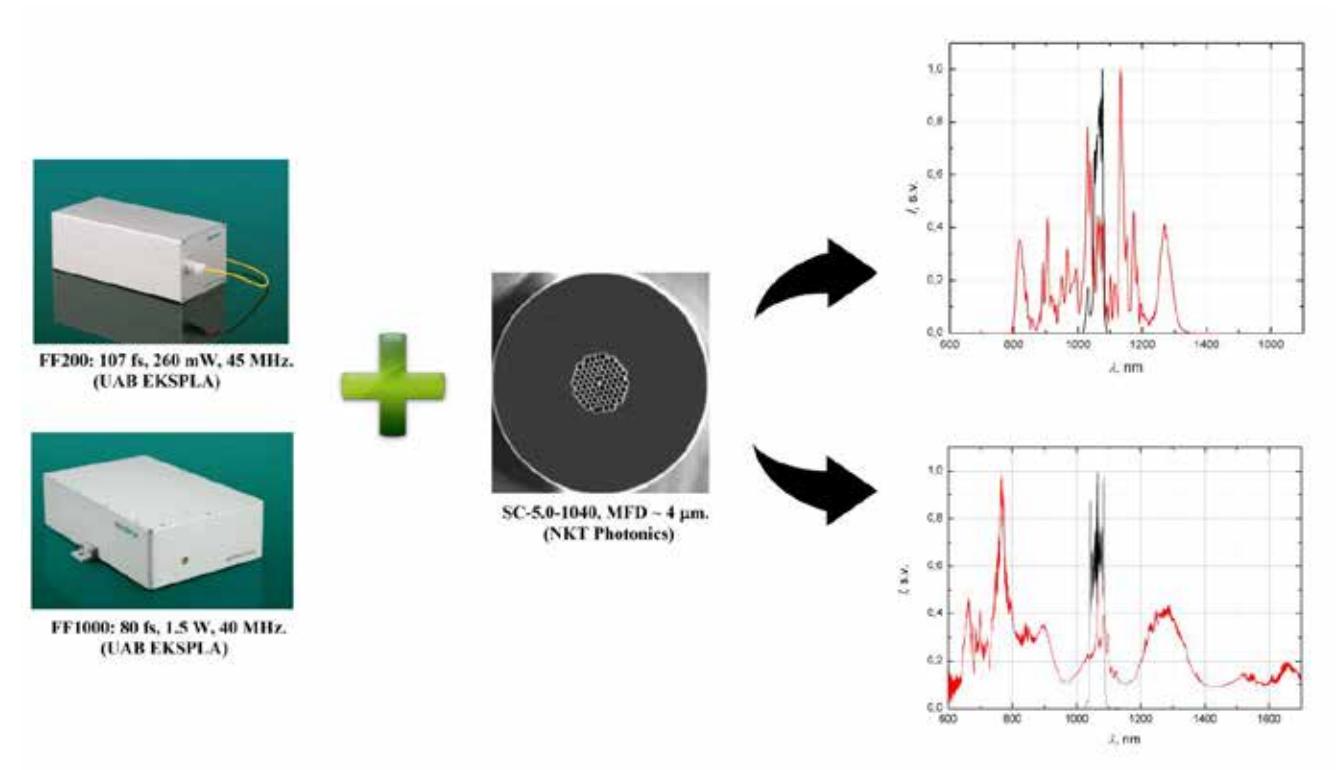
In this work we present experimental study of SC generation in photonic crystal fiber. The chosen PCF combines a high nonlinear coefficient (11 (W•km)-1) with zero dispersion wavelenght shifted to 1040 nm. Two laser sources with 1064 nm central wavelenght but different pulse energies were used. First, by fussion splicing an optical fiber from the laser output (~100 fs, 6 nJ pulses) to a PCF, monolitical SC source was produced generating broadband radiation in the 800 - 1400 nm range. When higher pulse energy (~40 nJ) free space couple laser was used, SC spectrum covered more than octave – from 600 nm to 1700 nm.