Molecular dynamics (MD) simulations are valuable tool to study the thermodynamics, structure and dynamics of ionic liquids on the atomistic level. It is noteworthy that these simulations allow to investigate relatively large systems containing thousands of atoms from which all static and dynamic observables can be extracted reasonably well. The main output of a simulation is a phase space trajectory and the specific challenge consists of using the detailed information about the atomic positions, velocities and forces to obtain relevant information about physics of the system studied.1
Room-temperature ionic liquids (RTILs), that are salts are liquids at ambient temperatures and pressures, provide desirable features such as very low vapor pressure, thermal stability, high ionic conductivity, non-flammability, and a large temperature range for which they remain liquid. One of the many advantages of RTILs is the ability to tune physicochemical properties such as density, viscosity, conductivity, and hydrogen bonding by selecting appropriate cations, anions, and polar or non-polar solvents. Interactions between different types of RTILs and water solvents are important because RTILs can absorb a large amount of water from the atmosphere.
Molecular dynamics (MD) simulations play an important role in understanding how condensed-phase properties of IL/water mixtures are linked to their microscopic structure and to the network of interactions formed by their components.2
The aim of this work are to verify the best setting for the simulations in term of accuracy and computation time and use them to study the structural and dynamical properties of the ionic liquid (1-decyl-3-methyl-imidazolium chloride ([Dmim][Cl])) and how they are affected by the presence of water molecules. The effect of parameter such as the non bonded interactions cut off and time step on the simulation results has been verified.
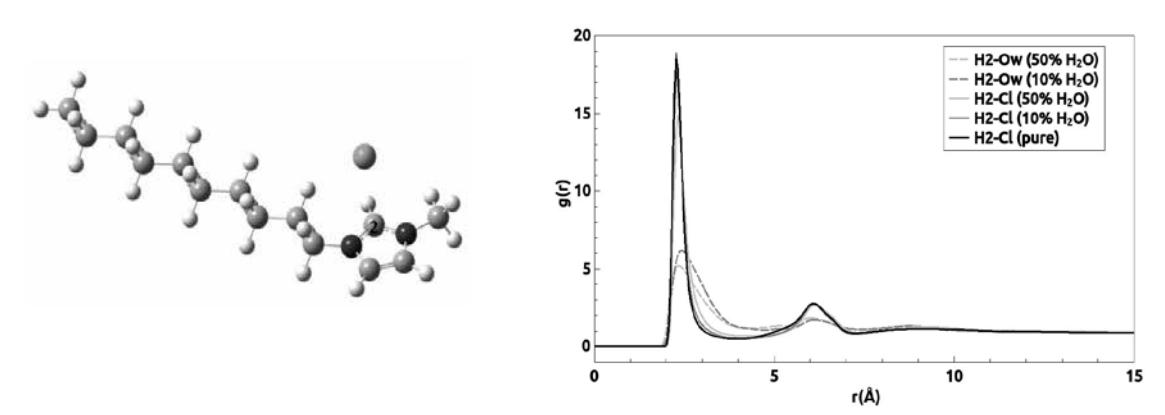
Using the Amber 14 simulation package3 we simulated both the pure ionic liquid, and its mixtures of varying water content. Changes in important bulk properties such as the density has been monitored, revealing that long simulation time (> 100 ns) are required to the system to reach equilibrium. An overall view of the structural properties of the investigated systems has been gained from the radial distribution functions $g(r)$ of a selected subset of atoms that have been calculated from the MD trajectories (see Fig. 1). Structural and bonding properties have been further analyzed by calculating spatial distribution functions (SDF). To elucidate the effect of water on the dynamic properties of IL/water mixtures, we computed the translational self-diffusion coefficients.
Detailed account of the results will be presented at the conference.