
Tetrahydrofuran (THF) is an organic heterocyclic compound with formula (CH2)4O. THF finds usage mainly as a precursor in polymerisation. Polar properties and wide liquid state temperature range makes THF a versatile solvent. The high-level ab initio calculations show that the global minimum of the THF molecule in a gas phase is an envelope (Cs) structure. [1, 2, 3] According to the latest benchmark calculations the absolute energy difference between the global minimum (Cs) and the first local minima, the twisted conformation (C2), is only 1.77 kJ/ mol-1.[4] Such low differences between global and local minima suggest a high flexibility of THF molecule at finite temperature and its barrierless adaptation to different conformations.
Matrix isolation comprises a category of experimental techniques in which guest molecules or atoms are trapped in rigid host materials. Because the species are embedded in a host material, the diffusion process is prevented and bimolecular reactions cannot take place except with the host material. After successful deposition of the matrix, the trapped guest species can be activated by irradiation and by low-temperature annealing.
Matrix isolation experiment was performed with concentration ratio of 0.5 THF and 500 nitrogen (matrix). In order to change the conformational equilibrium the temperature of the matrix mixture was varied during deposition in the large temperature range in different experiments by using hot nozzle matrix deposition technique.
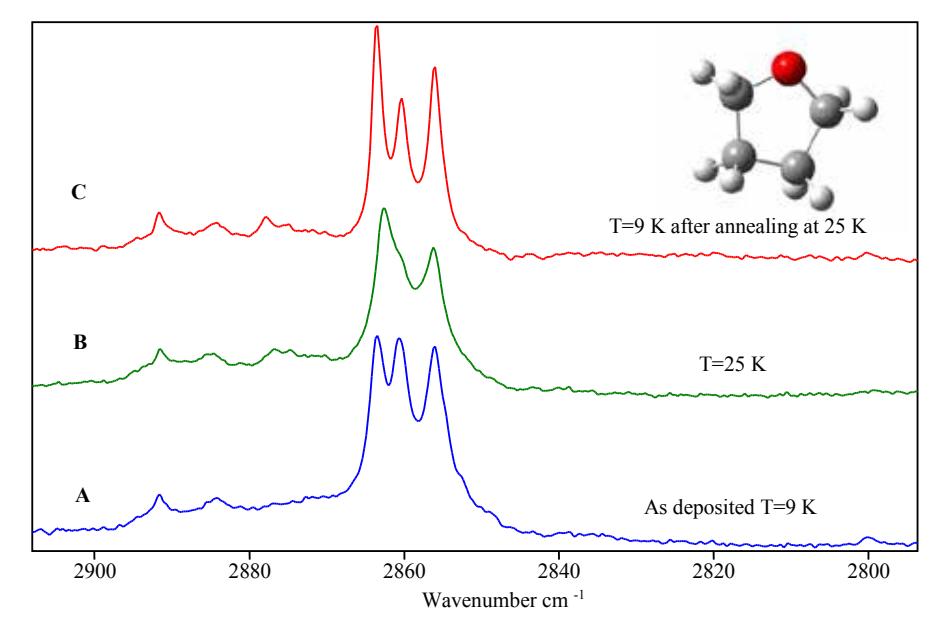
In the C-H stretch vibration range of the THF infrared absorption spectra we can observe the change of intensity of spectral bands associated with Cs and C2 conformers with heating up and cooling down the matrix (A and C). Additionally we have observed changes of Cs and C2 ratio when the sample is deposited at different hot nozzle temperatures. Detail analysis of the conformer structure and conformational dynamics will be in detail described on the poster.