
Water is a key element of life, consequently it draws vast amounts of attention from the scientists. Its unique structure and properties are being constantly investigated and discussed, but yet they are not entirely understood. Water has two remarkable properties, which are responsible for its unique role in chemistry: first, water forms strong hydrogen bonds, which are the reason why water is a liquid at ambient conditions. Second, water has the ability to dissociate by forming a hydronium $H_3O^+$ and a hydroxide ion $OH^-$. On a large scale, aqueous media are believed to be an ensemble of different kinds of clusters, positively and negatively charged. Protonated water clusters $H_3O^+(H_2O)_n$ are among the most important species of such clusters. Studies of the hydrated proton in water bulk or in water solutions are important for many chemical and biological areas. A special place among $H_3O^+(H_2O)_n$ species belongs to the protonated water dimer (PWD) $H_5O_2^+$. This system is the simplest protonated water cluster and it is of considerable importance both because of the interest in proton mobility from a biochemical point of view as well as the interest in the strong hydrogen bonding that takes place in these clusters. Consequently, PWD is subject of many theoretical and experimental investigations. It was stated that due to the large anharmonicity of the vibrational modes of this system, the infrared spectrum is quite complex. Therefore, further theoretical investigations are needed in order to make convincing assignment of the bands in experimental spectrum.
Structure of PWD was analyzed using B3LYP/acc-pVTZ; B3LYP/acc-pVQZ; MP4/cc-pVTZ and MP4/acc-pVTZ levels of theory. For all of these cases geometry optimization was performed for C2, Cs cluster symmetries as well as without symmetry restrictions (see Fig.1).
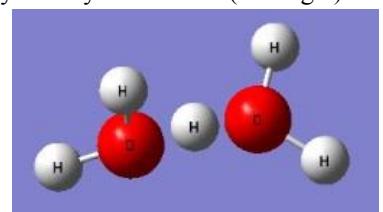
It is worth noting that due to C2 symmetry restriction (Fig.1 left) H-bonded proton located at the center of the hydrogen bridge. Different situation takes place for the Cs symmetry. H-bonded proton is closer to one of the H2O molecules and it is more correctly to say that rather forms the structure $H_3O^+ \cdot H_2O$. It is important to point out that only while using MP4/acc-pVTZ level of theory the $H_3O^+$ fragment becomes rather tetragonal than flat structure for all other levels of theory. Structural parameters and relative energies of equilibrium structures with different symmetries were discuss. IR spectra in harmonic and for some cases in anharmonic approximation were calculated. For detailed study of the anharmonic behavior of H-bonded proton vibrations 1D, 2D and 3D potential energy surfaces (PES) were constructed.
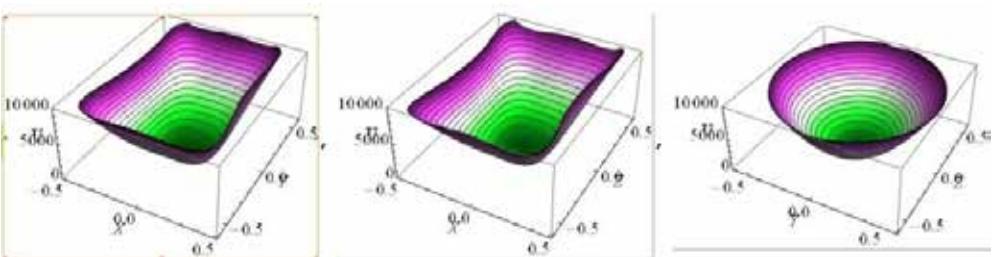
One can see that due to stretching motion (Fig. 2 – left and central) PES become strongly anharmonic. Frequencies of H-bonded proton vibrations were found by numerical solution of the multidimensional Schrödinger equations using Fourier [1] and DVR [2] methods. Strong coupling between normal modes is discourse.