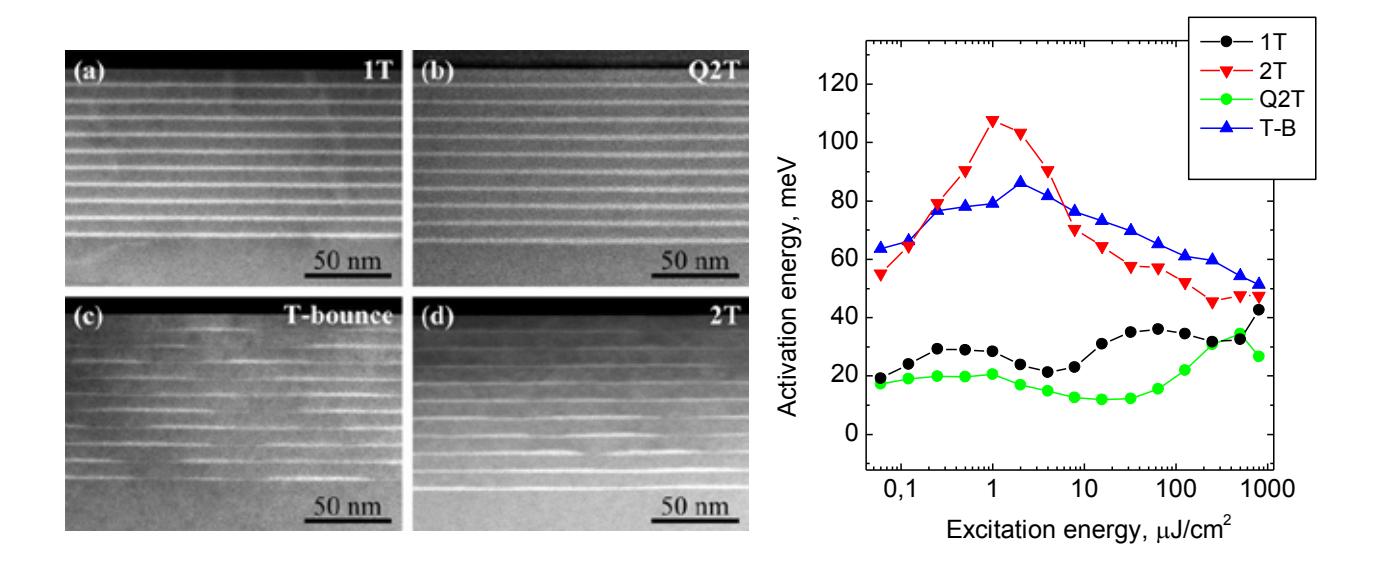
Over the last decade, performance of InGaN-based light emitting diodes (LEDs) has improved considerably to the point where they are now penetrating the outdoor and indoor general lighting. One of the key issues in the manufacture of high efficiency nitride-based heterostructures is the control of the In-composition in the InxGa1-xN quantum wells (QWs). One common approach is to grow the GaN barriers between the QWs at a higher temperature than the InGaN QWs themselves. This high temperature barrier growth has two potential impacts: reducing the density of defects in the barrier material and altering the morphology or composition distribution of the InGaN QW itself. In this work, there was investigated a matrix of four samples which was designed to separate the two effects: quality of GaN barrier and gross well-width fluctuations.
It was noticed, that samples with gross well-width fluctuations has lower coefficient of diffusion. It can be explained by the width of the QW reducing to zero in several places, leaving a "gap" which is filled with GaN. Larger PL peak position shift in samples with gross well-width fluctuations is due to lower density of localized states. It was supported by the calculated localization parameter $\sigma$ value which is equal to zero in samples with gross well-width fluctuations [1]. The higher activation energy $E_a$ indicates that in samples with gross well-width fluctuations deeper localization states are formed during QW's growth process.