
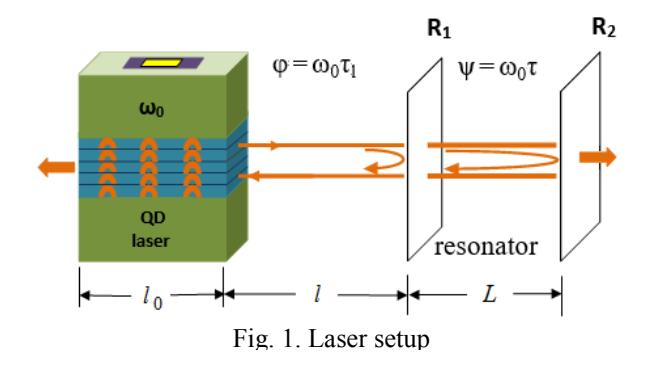
During recent years, the phenomena of self-organization and chaos have received considerable attention due to its fundamental and applied interests. In optical chaos-based communications, the chaotic waveform is generated by using semiconductor lasers with either all-optical or electro-optical feedback loops [1]. It is well known that optical feedback can considerably influence the dynamical behavior of a semiconductor laser. Due to the influence of the feedback, under the appropriate conditions, the system displays chaotic behavior appropriate for chaos-based communications. The quantum dots integrated cavity laser under the influence of optical feedback could be a key element for chaos-based communications systems. Here we consider a configuration of quantum dots laser under the influence of optical feedback from an integrated double cavity. We focus on the investigation of the dynamics of semiconductor lasers with quantum dots active medium shown in Fig. 1. The setup consists of a semiconductor laser operating under the influence of an external optical feedback from double cavity. The first mirror is located at distance $l$ from the laser front facet. The distance between first and second mirrors is $L$. The phase $\varphi$ in the air gap can be changed by a piezo-element. On the other hand, the feedback phase $\psi$ can be tuned, by the change in the delay time between the two mirrors.
For modeling of the dynamics of quantum dots laser under the influence of double optical feedback we use the following equations for the complex amplitude of the electric field E, the occupation probability in the quantum dot $\rho$, and for the carrier density in the quantum well N with the feedback strength $\Gamma_1$ and $\Gamma_2$ [2]
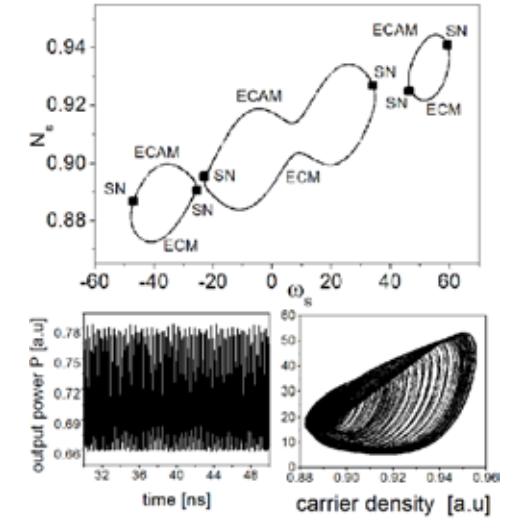
We have examined the stationary states (see Fig. 2 top) and dynamical behavior (see Fig 2 bottom) of semiconductor lasers shown in Fig. 1 using the set of equations (1) – (3) and the following main parameters $\tau_1$ = 0.2, $\tau_2$ = 0.5, $\alpha$ = 2.0, $\gamma_{np}$ = 500, C = 40, g = 1200, J = 20 [3]. Figure 2 (top) shows the panel distribution of external cavity modes and anti-modes i.e. stationary solutions of equations (1) – (3) in the plane of two parameters: Ns versus $\omega_s$. SN denotes saddle-node bifurcation. Figure 2 (bottom) presents the time evolution of the emerging power (left) and phase portrait (right) for the chaotic behavior appropriate for chaos-based communications. We show that the advantage of the proposed system compared to the conventional optical feedback is that the chaotic behavior occurs for short lengths of cavities, which makes more compact device. On the other hand, we show that under certain conditions two such laser systems could be synchronized when they operate under chaotic emitter-receiver configuration. We believe that our work provides a good basis for further research to optimize quantum dots semiconductor lasers with feedback for chaos based communications.