
Light-emitting diodes (LEDs) made from InGaN are considered to be the most promising next-generation lighting sources. Nevertheless, many puzzles remain regarding the physics of these devices. One of the unanswered questions is related to the potential fluctuations in InGaN/GaN quantum wells. More specifically, it remains unclear what is the influence of these fluctuations on radiative and non-radiative carrier recombination [1], and how they affect quantum efficiencies of LEDs.
In this study we have investigated carrier dynamics in InGaN quantum wells. Five programs have been written in order to simulate different components of carrier dynamics: diffusion, drift, non-radiative and radiative recombination, as well as carrier distribution in a quantum well. In addition, one program has been written to create a realistic model of InGaN potential fluctuations. A random-walk algorithm was used to simulate diffusion. Once the spatial scale is fixed, the temporal scale is then determined so that the actual diffusion constant is reproduced. The kinetic Monte Carlo algorithm was used to simulate drift. In both diffusion and drift we monitored the trajectories of particles; these were found to agree with theoretical predictions. Einstein's relationship was shown to hold when electric fields are not too strong. Simulations of non-radiative and radiative recombination were also in agreement with theoretical expectations.
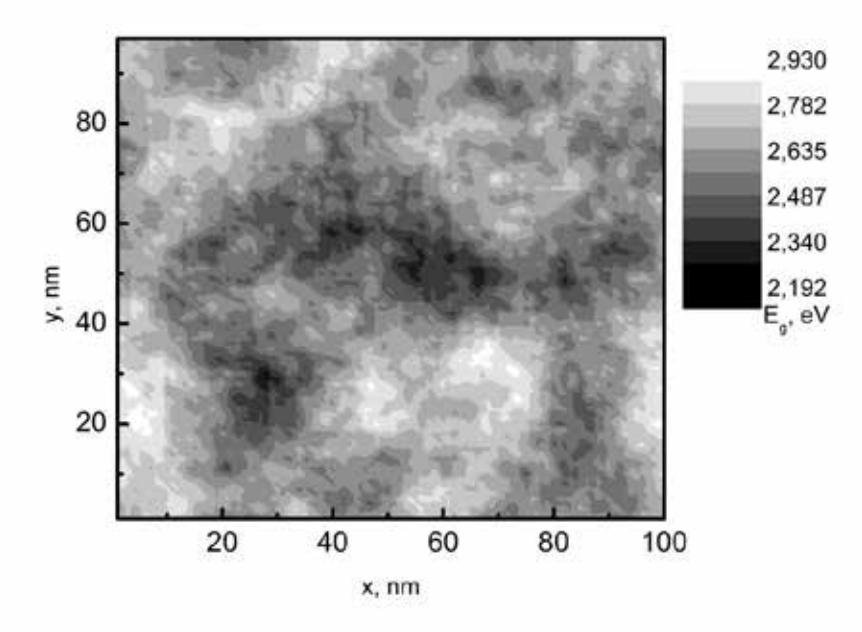
In this study a realistic model of InGaN potential fluctuations (Fig. 1) was created. We will use it further in order to explain physical effects which determine efficiency of LED.