
Despite decades of progress laser microfabrication has not achieved the flexibility required by industrial applications such as silicon (Si) photonics. 3D laser micromachining of silicon is a complex task and it is targeted by several groups worldwide [1, 2]. The difficulties of bulk Si microfabrication arise due to high absorption of light in visible, near-IR, UV spectral regions and its indirect bandgap. Propagation of the beam is deformed by free charges generated during microfabrication. This leads to the spreading of focal region [1] and inability to form structures with required dimensions. Therefore the spatial formation of laser light at the microscale is an essential step for laser microfabrication in the volume of semiconductors.
One way of spatial structuring of light in absorbing media is to construct superpositions of many beams with the same wavelength but different longitudinal wave vectors [3]. If the distribution of field in the axis of propagation is described by harmonic functions then truncated discrete Fourier series can be formed by superposition of such beams. These superpositions are called - frozen waves, due to their property of stationary longitudinal intensity pattern [4]. In this work we construct vectorial frozen waves of Bessel beams.
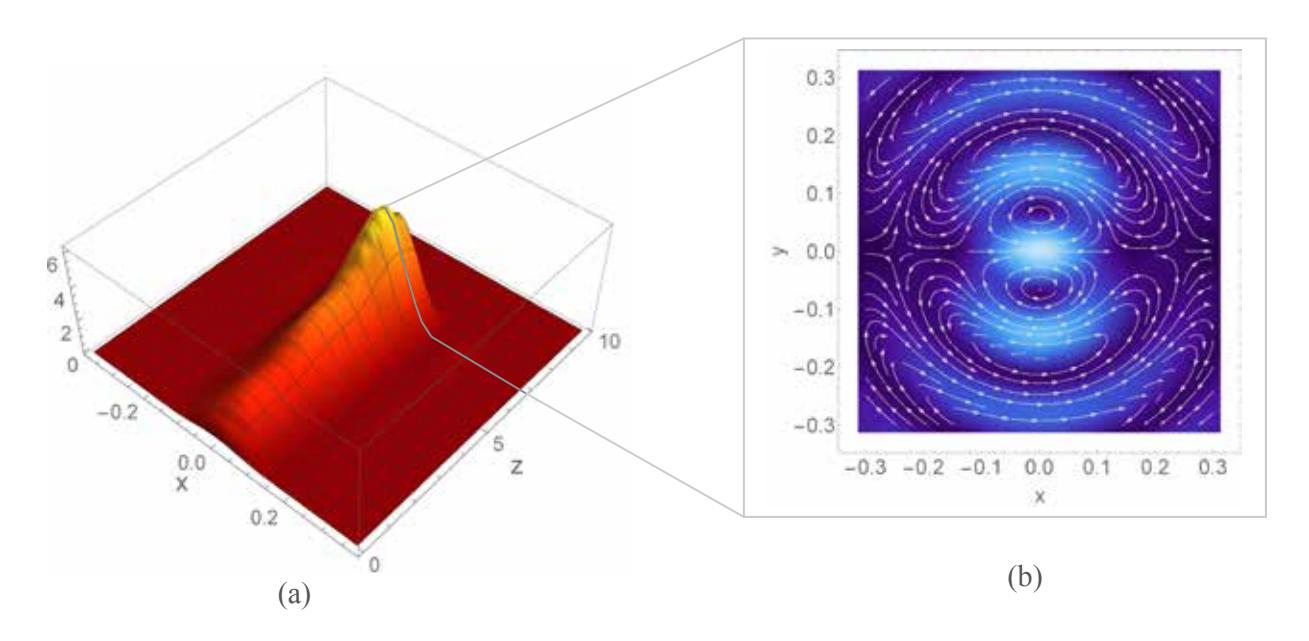
We investigate a new class of vectorial Bessel beams, which can overcome linear absorption and reach the micro- fabrication intensities inside the volume of a semiconductor material. We demonstrate that in case of these beams the behavior of either longitudinal or transverse component of electric field can be controlled on the axis of propagation.