
Technologies of high frequency electronic devices experience permanent developments, which allow for higher operation frequency, higher power and etc. One strategy for extension of the applicability of semiconductor devices beyond their transit-time-limited cut-off frequencies proposes to exploit the collective motion of charge carries - plasma waves [1]. The authors used comparably simple hydrodynamic transport concept to describe carrier motion within the channel of a field-effect transistor and proposed series of novel devices including terahertz detectors, frequency mixers and radiation sources. To illustrate the role of plasmons, the local carrier density in 2-DEG plane of a field-effect transistor was described using gradual channel approximation and by employing a planar capacitor formula: $n = CV_{sv}(x, t)/q$. Here C is the capacitance between 2-DEG plane and gate, $V_{sv}$ – a gate to channel voltage swing minus transistor threshold voltage.
The task of this work is further development of the hydrodynamic description by accounting high frequency dielectric properties of 2-DEG [2]. Similar device geometry as [1] (shown in Fig. 1) is used in our considerations. The necessity of improvement in hydrodynamic transport description comes into consideration when the wavelength of excited plasmons becomes comparable to gate-to-2-DEG separation.
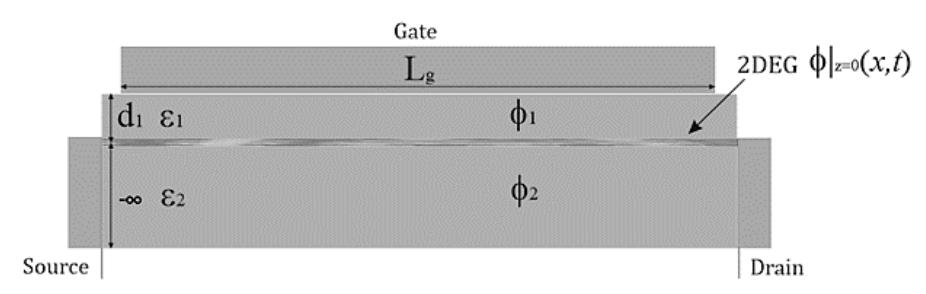
In order to find a response of two-dimensional electron gas to electromagnetic fields, at first a dependence of potential in the 2-DEG plane on carrier density is needed to be found. Therefore, we solve the Poisson equation and apply appropriate boundary conditions.
The improved model allows to derive potential function to the response of perturbation by external charge $q_{\text{ext}}$:
$$\Phi_1(k)|_{z=0} = -\frac{q_{\text{ext}}}{\varepsilon_0(k\varepsilon_1 \coth(kd) + k\varepsilon_2 + k_s(\varepsilon_1 + \varepsilon_2))}\tag{1}$$Here ks is a screening wavevector, ks = $\frac{e}{\varepsilon_0(\varepsilon_1+\varepsilon_2)}\frac{\partial n(\varphi)}{\partial \varphi}|_{\varphi=\varphi_0}$. The resulting dispersion relation for plasmons:
$$\omega^2 - i\frac{\omega}{\tau} - \frac{e^2 k^2 n_0}{\varepsilon_0 m (k\varepsilon_1 \coth(kd) + k\varepsilon_2 + k_s(\varepsilon_1 + \varepsilon_2))} = 0\tag{2}$$For kd >> 1 and $\omega\tau$ >> 1 it reduces to well-known dispersion for ungated 2D plasmons:
$$\omega^2 = \frac{e^2 n_0}{\varepsilon_0 m(\varepsilon_1 + \varepsilon_2)} k\tag{3}$$In this work, we derived dispersion relation for plasmons in gated two dimensional electron gas that can be used for a wide range of plasmon wavevectors. The theory allows improving existing plasma-wave-based terahertz detector models.