
Monitoring astronauts' cardiac health on the International Space Station requires cheap, simple and easily made biosensors. One possible solution is a fully printable paper based biosensor [1]. The sensor's electrodes and fluidics will be printed using inkjet and stencil printing on standard chromatography paper.
Cardiac troponin-I (cTnI) is used because it is a cardiac health biomarker and an indicator of acute heart failure. The specific binding affinity of these proteins to antibodies probes on the carbon nanotube (CNT) electrode will be characterized to assess the capture efficiency of the biosensor (Fig. 1). A high density mesh of CNT coated paper fibers should improve binding between proteins and ligands if the sample fluid flows through the CNT network and not across it. Scanning electron microscopy (SEM), cyclic voltametry (CV), differential pulse voltammetry (DPV) and electrochemical impedance spectroscopy (EIS) will be used to characterize protein binding and thus detection.
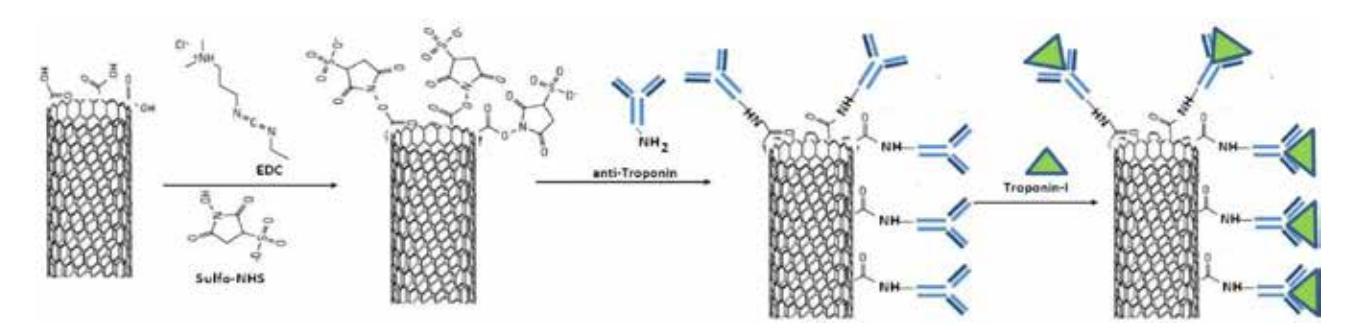
Early data from SEM imaging suggest good conductivity of paper fibers covered with CNTs. Further work includes imaging CNTs with a protein and a specifically bound ligand. The purpose of this work is to use a streptavidin-biotin model to optimize the CNT electrode geometry for high cTnI binding by characterizing CNT coating process, protein binding and sensitivity of the electrode.
Binding characterization was done by SEM imaging of CNT coated paper fibers with immobilized streptavidin and bound biotin conjugated with Au nanoparticles. This provided evidence for carbon nanotubes being a suitable electrode material on paper based biosensor. Statistical analysis of SEM imaged Au nanoparticles revealed significant differences between different electrode geometries.
CV and DPV measurements of potassium ferricyanide (K4Fe(CN)6) solutions assessed the sensitivity of the electrode. The lowest concentration of potassium ferricyanide solution when redox event signal was registered is 1-10 μM which is sensitive enough to detect small myocardial infarction [2].
The results show that this model is suitable to be used for characterizing cTnI binding to the CNT electrode. EIS will be employed as a more sensitive method for protein detection.