Magnetic thin films with periodic arrays of holes (antidots) show promising results as elements of various spintronics devices (sensors, magnetic field transistors etc.) and as a media for high density magnetic recording (storage density >1 Tbit/in2) [1]. In this work the technology of magnetic antidot fabrication with different pore diameters (10–135 nm) is presented and the dependence of antidot parameter on their magnetic properties is discussed.
Co/Pd antidots were fabricated by deposition of Co/Pd multilayers on nanoporous Al2O3 templates [2, 3]. Anodic Aluminium Oxide (AAO) templates were fabricated by anodizing of aluminium film deposited on silicon wafers. The template porosity was controlled by parameters of anodization. To determine the contribution of antidot morphology to magnetic properties of the system Co/Pd multilayers on flat Si substrate were also prepared.
SEM imaging confirmed antidot formation and indicated that deposited material is concentrated in the form of small grains between the pores. XRR and XRD measurements revealed a presence of CoxPd1-x alloy at Co/Pd MLs interface.
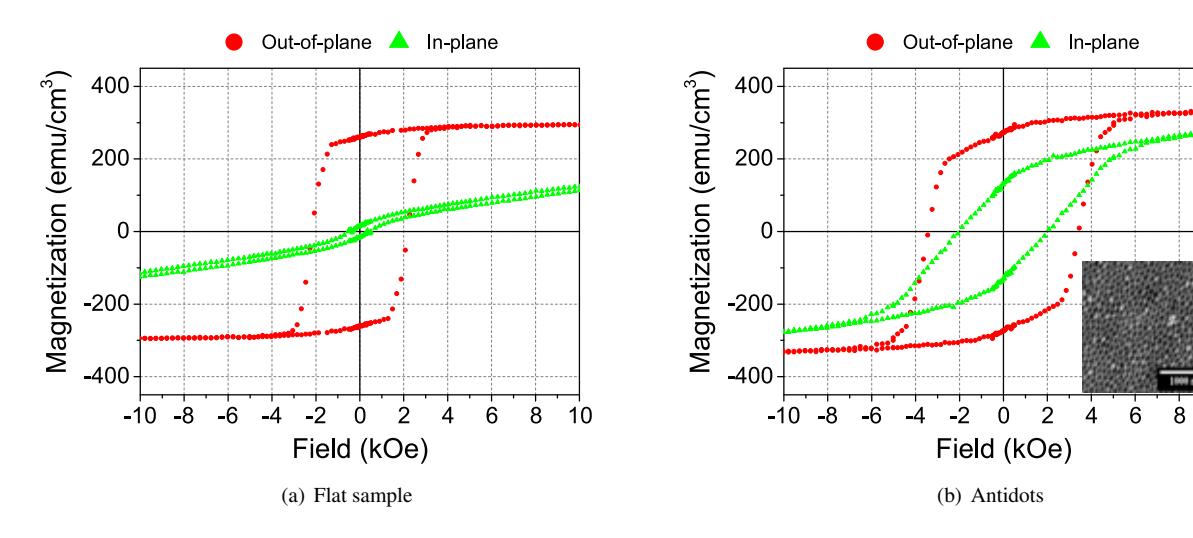
Magnetization curves (Fig. 1) demonstrated perpendicular magnetic anisotropy for continuous multilayers and its conservation for antidots. The value of magnetic anisotropy constant for antidots is inversely proportional to antidot diameter. A twofold enhancement of coercive field was detected for antidots below 100 nm and it was explained by pinning of magnetic moments on the pore borders. MFM imaging of antidots showed complicated magnetic contrast with small magnetic domains and areas with magnetic moments distorted from perpendicular direction in comparison to continuous films. It was associated with complex distribution of magnetic material due to developed surface morphology of antidots.