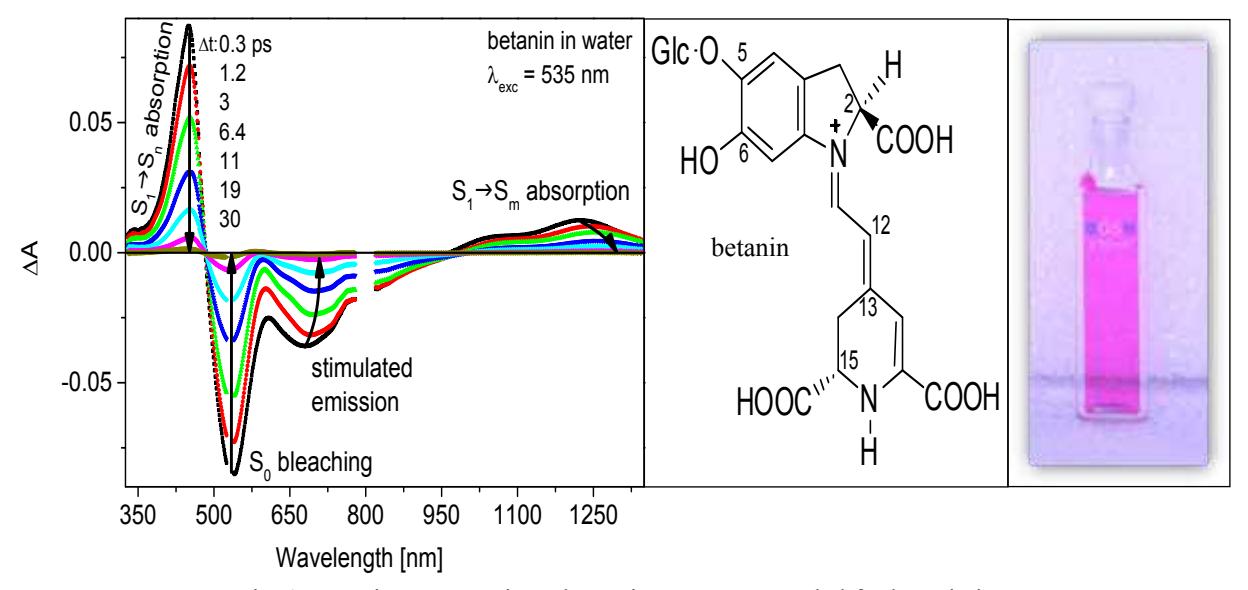
Betanin (Fig. 1) is commonly used as a purple pigment (E-number E162) in pharmaceutical, food and cosmetic industries [1], located in plant vacuoles of Caryophyllales. Sun-screening function of betanin indicates its photoprotective role in plants [2]. Light absorption at $\lambda \sim 535$ nm results in the excitation of betanin to its first singlet excited S1 state. Since betanin in the S1 state is a short-lived species, and S1 deactivation pathways are unknown, we applied femtosecond transient absorption spectroscopy to describe the mechanism and kinetics of betanin S1 decay. Figure 1 shows that betanin in the S1 state has distinctive S1$\rightarrow$Sn and S1$\rightarrow$Sm (n> m> 1) absorption bands at ca. 450 and 1220 nm, respectively [3]. The betanin S1 state lifetime is very short (6.4 ps in water) due to highly efficient S1$\rightarrow$S0 radiationless relaxation. Other S1 state deactivation pathways as photoproduct or excited T1 state formation are absent, while fluorescence of betanin is characterized by a very low quantum yield (0.0007 in H2O) [3]. We suggest that the S1 state decay is preceded by a strong change in geometry, since the S1 lifetime is four times longer in viscous ethylene glycol (27 ps) in comparison to methanol (7.7 ps) [3]. Observed light-to-heat conversion in betanin supports its photoprotective role in plants.