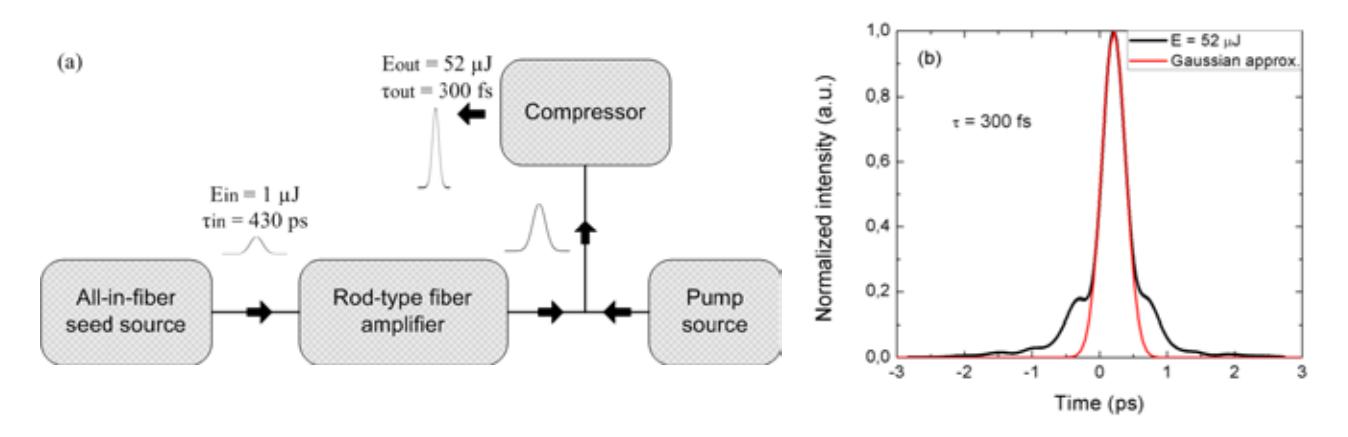
Pulsed fiber lasers are widely used for micromachining applications because of their reliability, excellent beam quality and high output power. High peak power ultrashort pulse fiber lasers are usually realized using fiber chirped pulse amplification (FCPA) technique [1]. Before passing through the amplifier medium, the pulses are temporally stretched to a much longer duration by means of a strongly dispersive element. This reduces the peak power to a level where nonlinear pulse distortion effects in the gain medium are suppressed. After amplification laser pulses are compressed using a pair of diffraction gratings. FCPA technique using large mode rod-type photonic crystal fiber (PCF) benefits from large mode area which helps to reduce nonlinear effects and increase pulse energies from the amplifiers. Compressed pulse energy could reach the level of mJ in this configuration [2]. Maximum pulse energy and quality extremely depends of the intitial pulse parameters. Pulse duration and spectrum could be strongly affected by the seed source parameters. In this work we constructed FCPA system using rod-type Yb doped PCF amplifier and optimized seed source parameters to acheive highest pulse energy from the system. Schematic representation of laser is shown in Fig. 1(a).
Passively mode-locked picosecond all-in-fiber oscillator was used as a seed source in FCPA system. Near transform limited 1 ps pulses from fiber oscillator were stretched up to 430 ps duration, while their spectrum was broadened to 12 nm, by self-phase modulation in passive fiber. Broad spectrum enables to acheive femtosecond duration of the pulses in the output of the laser. Chirped pulses were amplified in a single mode fiber amplifier up to $1\mu J$ energy. Finally the pulses were amplified in the power amplifier which was an 80 cm long single mode Ytterbium-doped polarization maintaining rod-type PCF with large mode area (NKT Photonics). A core diameter of the fiber was 55 μm and pump cladding diameter was 200 μm. Cladding pump configuaration was used in this work. The system was operated at different repetition rates from 250 kHz to 1 MHz. Output power 13-18 W was obtained at these repetition rates. Pulse energy up to 52 μJ was achieved at repetition rate of 250 kHz. A pulse duration of 300 fs was measured after pulse compression. The autocorrelation trace is shown in Fig. 1(b). Output beam quality at the output of the amplifier was evaluated. The best-fit M2 values were close to 1.1.