
Nowadays polar diatomic molecules comprising atoms of different alkali metals offer prospects for the realization of new forms of quantum matter with possible applications to quantum information [1]. The YbCs molecule is a heteronuclear polar diatomic dimer which has unpaired electron. This gives the molecule paramagnetic properties and opportunity to be manipulated by magnetic fields. An experimental search for a permanent electric dipole moment of the electron and for constructing lattice-spin models for quantum computing is also among possible applications of such a molecule. In this case it is necessary to know the exact forms of the potential energy curves (PECs) of the electronic states, as well as the spectral, energetic and dynamic characteristics of their rovibronic states. To predict the most probable vibronic transitions it is necessary to know its intensity. The intensity of vibronic transitions is proportional to the product of the Franck-Condon factors (FCFs) and fourth power of the transition frequencies. Thus FCFs are crucial for the simulation of the spectrum. The system of electronic states of the molecule YbCs has not been investigated experimentally and therefore calculations of the Franck-Condon factors are the actual task.
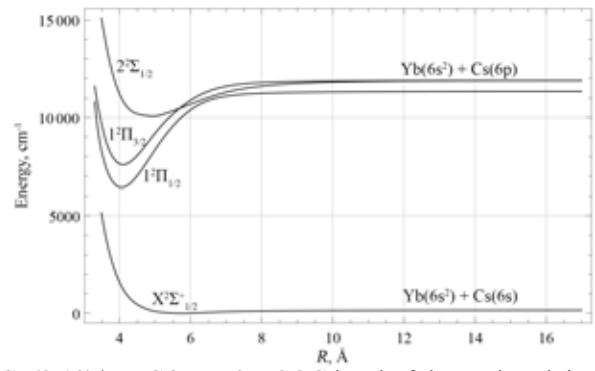
In this work we study the terms of the YbCs molecule corresponding to 2 asymptotic limits: Yb(6s2) + Cs(6s) which comprises ground state $X^2\Sigma^+$ and Yb(6s2) + Cs(6p) comprising $2^2\Sigma^+$, $1^2\Pi$. After applying the spin-orbit coupling (SOC) the states are altered into $X^2\Sigma^+_{1/2}$, $2^2\Sigma^+_{1/2}$, $1^2\Pi_{1/2}$ and $1^2\Pi_{3/2}$ respectively (Fig. 1). The terms of the molecule were obtained at SA-CASSCF(3,12)/XMCQDPT2 level of theory, taking into account the SOC by using the one-electron Pauli-Breit operator.
The FCFs were calculated for the vibronic transitions between relevant ab initio states. These calculations were performed between the fixed vibrational level v' of the upper electronic state and the sequence of vibrational levels v'' of the ground electronic state (applying the selection rules $\Delta\Omega = 0$ or $\Delta\Omega = \pm1$). The FCFs for $2^2\Sigma^+_{1/2}\to X^2\Sigma^+_{1/2}$, $1^2\Pi_{1/2}\to X^2\Sigma^+_{1/2}$ and $1^2\Pi_{3/2}\to X^2\Sigma^+_{1/2}$ transitions are shown in Fig. 2.
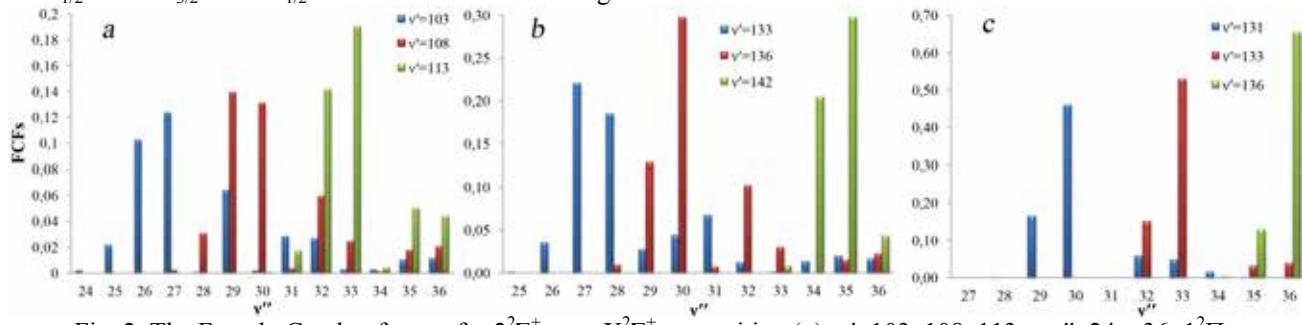
The equilibrium internuclear distances for $X^2\Sigma^+_{1/2}$, $2^2\Sigma^+_{1/2}$, $1^2\Pi_{1/2}$, $1^2\Pi_{3/2}$ are 5.775 Å, 4.950 Å, 4.025 Å and 4.100 Å respectively. From FCFs distribution (Fig. 2) it is seen that the most probable vibronic transitions are for states near the dissociation limits. For the $1^2\Pi_{3/2} \rightarrow X^2\Sigma^+_{1/2}$ transitions the nonzero FCFs have a distribution with larger values than for the other transitions under consideration.