
Indolo[3,2-b]carbazoles (ICZ) is a popular class of organic materials for various electronic applications. They have been used in a number of devices such as organic light-emitting diodes (OLEDs) [1], organic field-effect transistors (OFETs) [2], solar cells [3], etc.. ICZ is an important unit to synthesize various oligomers and polymers with interesting electrical, optical, magnetic and other features. ICZ molecules have ladder-type planar structure, similar as the pentacene, and two nitrogen atoms in the carbazole fragments, which provide electron-donating ability [4]. Moreover, because of high glass transitions temperature, ICZ compounds possess great thermal and morphological stability under ambient conditions [5]. Optimization of chemical, physical and structural characteristics is still important problem which has to be solved. For excellent performance and practical applications it is essential to understand the influence of different substituents to the behavior of ICZ compounds.
In this work, six new ICZ derivatives with different connected substituents were investigated. Steady-state and time-resolved absorption and fluorescence spectroscopy methods were used to study their spectroscopic properties in solutions and in solid films, and to reveal differences among molecules caused by different substituents. Quantum chemical calculations were also performed to support the experimental data.
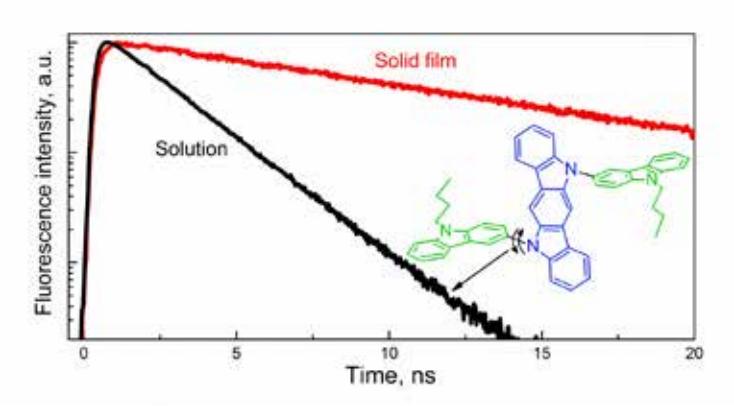
Absorption and emission spectra of indolo[3,2-b]carbazole materials red-shift by extending ICZ core with addition of substituents. The substituents also significantly influence fluorescence yields of these compounds, and their impact is different in solutions and in solid films (Fig. 1). Theoretical calculations demonstrated that charge redistribution during HOMO-LUMO transitions takes place mainly in cores of ICZ compounds, however slightly including substituents, which orientations change in the excited state. We conclude that restricted conformational motions of the substituents in solid films lead to longer fluorescence decays and higher fluorescence yields. Consequently, spectroscopic properties of ICZ compounds may be significantly altered by attaching substituents at different positions of ICZ molecules, however, in order to maintain their high fluorescence yield, conformational motions of the substituents shall be restricted.