Self-assembling quantum dots (QDs) due to atomic-like quantum confinement are particularly attractive for fundamental research and various applications in optoelectronics, such as infrared photodetectors, lasers, optical amplifiers, etc. Alongside material composition the shape engineering of QDs is the key issue to control the electronic and optical properties. Vertically elongated QDs, also referred to as quantum rods (QRs), are novel quantum heterostructures representing the intermediate confinement between 0-D and 1-D [1].
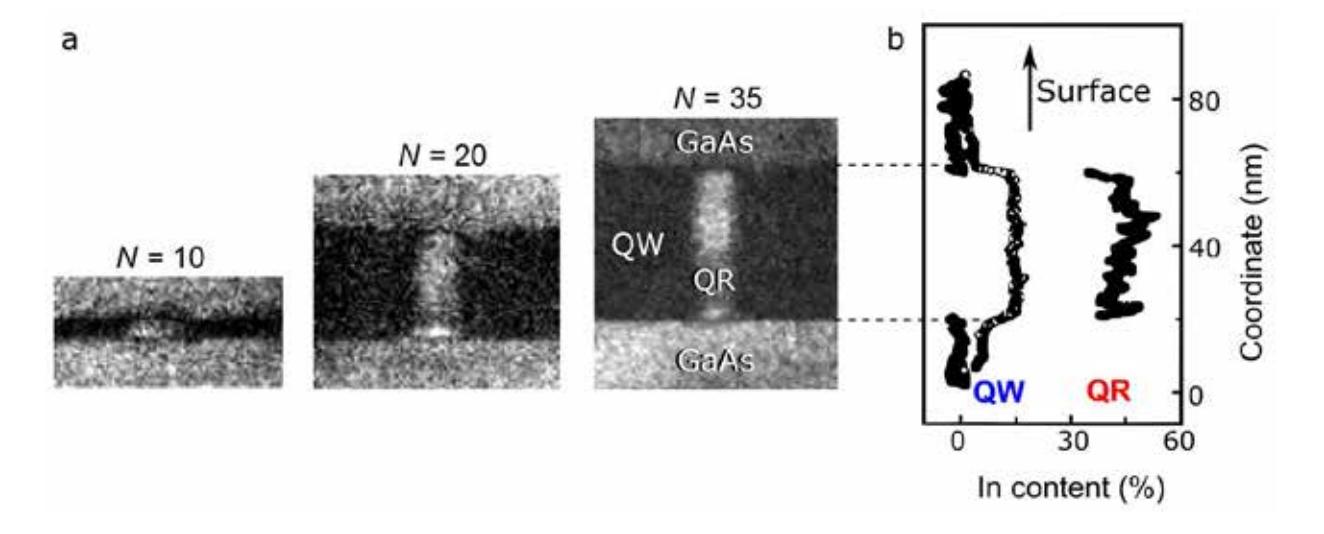
The QR samples studied were grown on a semi-insulating (001) GaAs substrate by molecular beam epitaxy. GaAs buffer layer was followed by 200 nm-thick Al0.2Ga0.8As layer. QRs of different height were then formed by depositing N = 10-35 periods of GaAs/InAs SL (3 and 0.64 monolayers of GaAs and InAs, respectively) on the QD layer (Fig. 1a) using either As2 or As4 source. Thereby, In-rich InGaAs QRs were embedded within In-reduced InGaAs quantum well (QW) [Fig. 1b] and this structure was sandwiched between two GaAs layers, each 100 nm-thick.
In this work we present an in-depth study of the effect of growth mode by using different As sources along with the impact of height of the QR (number of SL periods deposited) on the optical properties of InGaAs nanorods. Temperature-dependent photoluminescence (TD-PL), photoluminescence excitation (PLE) and photoreflectance (PR) spectroscopy in 3–300 K temperature was used in the study [2].
Optical spectra of QR structures are dominated by excitonic transitions related to ground-state (GS) and excited-state (ES) in the InGaAs QRs, along with optical transitions related to quantum well (QW) states. The TD-PL spectra shows that the PL peak energy has a red-shift that deviate from the Varshni formula. Moreover, we have observed unusual temperature dependence of the GS transition linewidth. The TD-PL spectra are discussed in terms of thermalized redistribution of the carriers among the QRs of different sizes. The PL intensity dependence on temperature plot of the As2- and As4-grown QRs shows different quenching for each sample. The origin of PL intensity quenching with temperature is discussed referring to the QR electronic energy structure revealed from PR spectra and calculations performed within the effective mass approximation.