
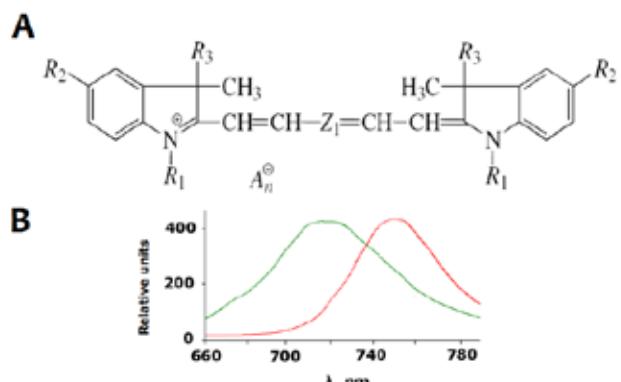
Photodynamic therapy is based on the excitation of cell-accumulated photosensitizer with specific light source, resulting in generation of ROS and free radicals which promote cell death [1]. Clinically approved photosensitizing agents are used for treating cancer or microbial infections. We investigated the phototoxic activity of a novel tricarbocyanine indolenine dye TICS No. 150 (Fig. 1A). Due to its red light absorbance (Fig. 1B), this dye emerged a promising agent for photodynamic therapy [2]. However, its potential phototoxic antimicrobial effect was not explored yet.
We aimed to examine the phototoxic effect of TICS No. 150 in bacterial and cancer cells and investigate its mechanism of action. To address these questions we performed a series of experiments on bacterial Salmonella enterica and eukaryoric prostate cancer cells, ehich were incubated with photosensitizer TICS No. 150 and irradiated with 720 nm laser diode light.
We found out that TICS No. 150 is phototoxic to Salmonella enterica cells in time- and dose-dependent manner (Fig 2). Mutant bacteria with shorter lipopolysaccharide in outer membrane are more sensitive to TICS No. 150 photodynamic effect. TICS No. 150 remains non-toxic until it enters the cell. The sensitivity of Salmonella enterica cells to the dye can be enhanced by increasing the permeability of outer cell membrane.
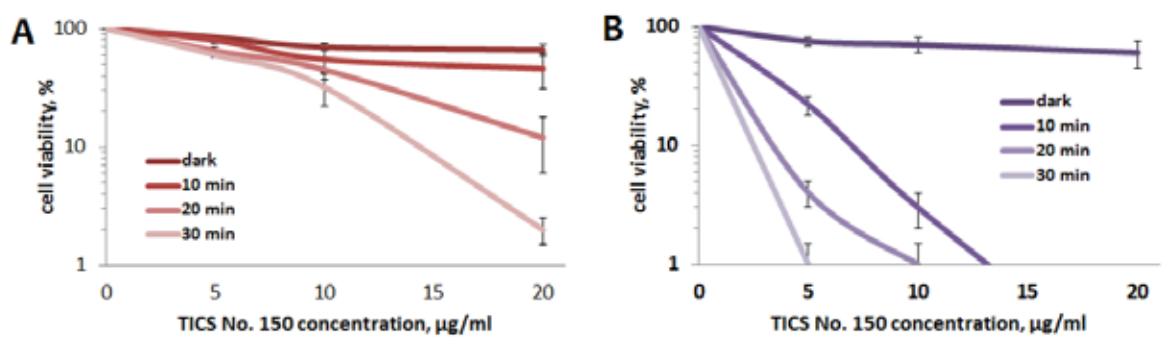
Moreover, TICS No.150 also showed considerable in vitro photoxicity to prostate carcinoma cells in time- and dose-dependent manner. TICS No.150 acts by generating singlet oxygen, which causes cell damage and induces apoptosis.