
Cross-polarization (CP) is a well-known solid-state nuclear magnetic resonance spectroscopy (SS NMR) technique. Originally it was developed for signal-to-noise ratio enhancement and experiment time reduction [1]. Considering the experiment involves a process between different spin species it is interesting area because information about these dipoles could be uncovered. In present work, CP kinetics of ammonium dihydrogen phosphate (ADP) is investigated. The physical reasoning for choosing ADP was: i) ammonia and phosphoric acid forms tetragonal crystal structure, hence it is easier to understand CP kinetics, ii) intermolecular distances are known from X-Ray, Neutron diffraction analysis [2]. Thus the purpose of the work is to confirm that CP-MAS is a complementary method for solid-state crystallography.
The experiments were performed using Bruker AVANCE III HD SS NMR spectrometer. The resonant frequencies were 400 MHz and 162 MHz respectively for 1H and 31P. 1H→31P CP kinetics were obtained using 498 equidistance time domain points. 7 kHz Magic Angle Spinning (MAS) was applied. Temperature was varied from 233 K to 363 K.
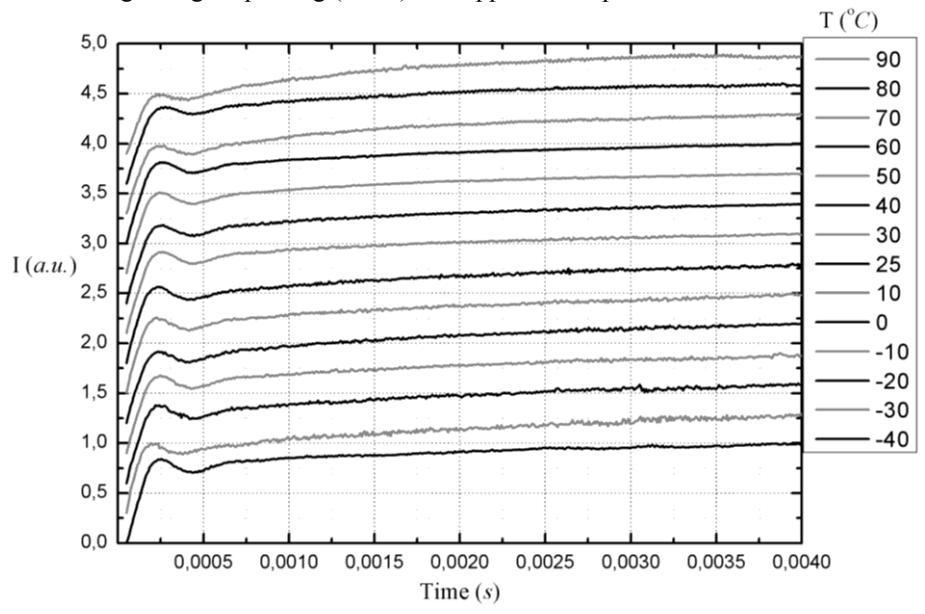
Obtained CP kinetics had certain type of curve shape. It has been seen, that the shape does not change in different temperatures and there is some sort of oscillations at the beginning. In NMR crystallography several models for CP are present. For compounds like ADP (that has high order in structure) I-I*-S model is used. In this model, I* and S spin pair (1H and 31P respectively) acts like two coupled pendulum in oscillatory manner [3]. Oscillations then are damped by subsequent spin-diffusion. This model results that signal dependency to time is given by Eq. (1):
$$I(t) = I_0 \exp\left(\frac{-t}{T_{1\rho}}\right) \times \left(1 - \lambda \exp\left(\frac{-t}{T_{df}}\right) - (1 - \lambda) \exp\left(\frac{-3t}{2T_{df}}\right) \cos\left(2\pi \frac{b \cdot t}{2}\right)\right)\tag{1}$$Enabling nonlinear curve fitting to this function, gives numerical results: diffusion time is around 3 ms and dipolar coupling – 3000 Hz respectively. Dipolar coupling is a function of distance, this would give that the distance between two spins is about 0.25 nm. In present work it has been shown, that in this temperature range, ADP crystal remains stable in the aspect of structural properties: spin-diffusion time $T_{df}$ and dipolar coupling $b$ are invariant to temperature.