
The aim of the project was to analyze temperature evolution of 2,6-diaminopurine (DAP) crystal structure. DAP is a nucleobase, a derivative of adenine present in nucleoacids, which can be used to compare Watson-Crick pairing in DNA. Investigating the properties of analogues of nucleobases may contribute to our knowledge about nucleic acid properties in general and give an opportunity to find novel ligands binding to DNA, what is essential for drug design.
The main part of the project was based on the single-crystal X-ray diffraction experiments. The single crystals of DAP were measured in different temperatures ranging from 100 to 320 K. Due to the temperature rise, subtle, untrivial changes in diffraction pattern were observed. The structures were refined using two methods – Independent Atom Model (IAM) and Multipole Model (MM). IAM is a standard model, in which molecular charge density is described as the sum of spherical, isolated atoms. In turn, Hansen-Coppens MM takes into account also aspherical deformations, what allows to properly model the charge density on molecular bonding and lone pairs.
What essential, charge density is strongly correlated with thermal motion of atoms, thus the proper de-convolution is needed. Measurements in low temperature reduce thermal vibrations and hence increase the resolution limit, up to which the data can be collected. More accurate charge density model allows to obtain better thermal motion model. For this reason, high-resolution charge density measurement at 100 K was conducted. Obtained data were then refined using MM.
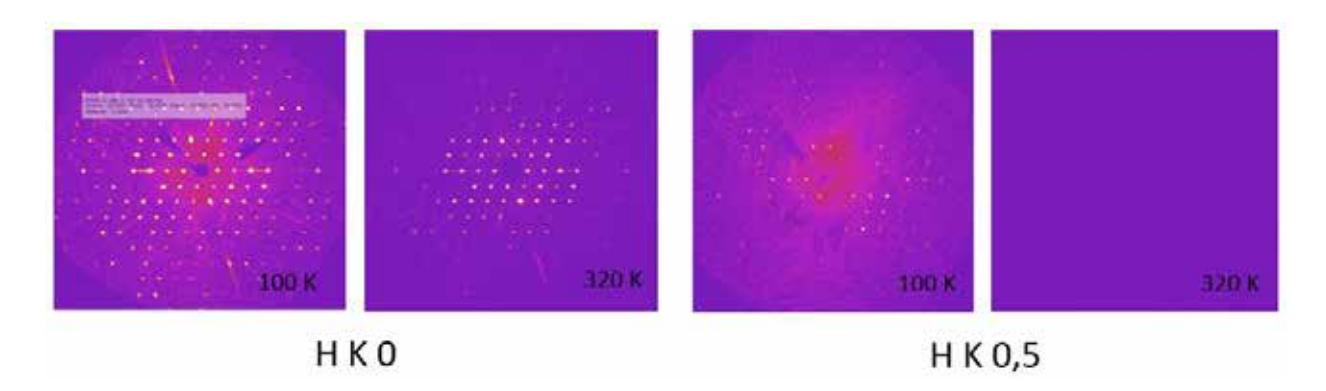
Unit cell parameters and atomic displacement parameters variations within temperature changes were noticed. The accurate analysis of observed variations was performed using the parameters transferred from MM.
To complement X-ray measurements, differential scanning calorimetry (DSC) and thermogravimetric analysis (TGA) experiments were also performed. These two methods enable to notice phase transitions or dehydration in sample, however existence of phase transition in case of DAP was not confirmed (only dehydration process was definitely proved).
Preliminary results suggest that DAP crystals have commensurate structure, which can be also described as a superstructure.