
Thermally induced lens in high power solid state lasers is one of the main issues for high average power scaling possibilities. At high temperature gradients it becomes important to take into account the temperature dependence of the thermal, mechanical and optical parameters of the crystal. We discuss a case of steady-state radial heat flow in YAG cylindrical rods with radially symmetric heating distribution. This allows to simplify the problem enough to obtain simple solution for radial temperature distribution for various heat load distributions q(r) :
$$T(r) = T_R \left[ 1 + \frac{(1 - \xi)q_2(r)}{k(T_R)T_R} \right]^{\frac{1}{1 - \xi}}, \quad T_R = T_a + \frac{q_1(R)}{hR}, \quad q_1(r) = \int_0^r q(\rho)\rho d\rho, \quad q_2(r) = \int_r^R \frac{q_1(\rho)d\rho}{\rho}, \quad \tag{1}$$where R is the radius of the rod, $T_R$ and $T_a$ are the temperatures at the cylindrical surface of the rod and cooling liquid respectively, h is the heat transfer coefficient, $k(T) = k_0 (T_r/T)^\xi$ is the coefficient of thermal conductivity, $T_r$ is the reference temperature. The case $\xi = 0$ is that of a constant conductivity. Sometimes $\xi = 0.7$ is used [1]. $\xi = 1.0$ is more validated experimentally. For this case $T(r) = T_R \exp(q_2(r)/k_0T_r)$. Formulae (1) are very convenient for numerical calculations of temperature distributions. We investigate 4 different pump distributions with the same total loading power $P_h = 60$ W for the YAG rod with R = 2 mm and length L = 10 mm (Fig. 1a). Temperatures were
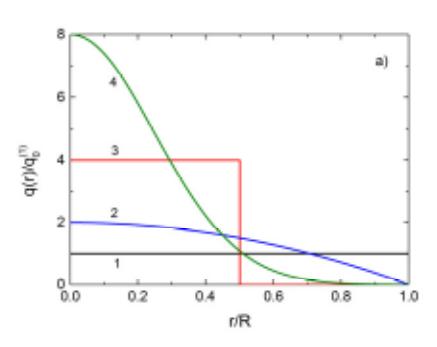
calculated using parameters $\xi=1.0$, $k_0=0.105$ W/(cm K), h=2.0 W/(cm2K). It should be noted that the expansion method used in [1] is not applicable for Gaussian beam with radius $w_p=1$ mm used here. For temperature independent thermo-optic coefficient dn/dT and expansion coefficient $\alpha$ the optical path difference may be calculated using corresponding formulae from [2] which take into account the change of refractive index by temperature gradient induced stresses. In this work, we generalized these formulae for temperature dependent parameters dn/dT and $\alpha$ [3]. Paraxial radial and tangential focal lengths calculated using temperature independent ($f_{r,\theta}(T_r)$) and temperature dependent ($f_{r,\theta}(T)$) YAG parameters are presented in Table 1. It is seen that its values depend strongly on pump distribution used and temperature dependence of parameters. For each pump shape temperature dependence of parameters decreases the value of the focal length by a factor of at least 1.5.
| Uniform | Parabolic | Top-Hat | Gaussian | |
|---|---|---|---|---|
| $f_r(T_r)/f_r(T)$ , mm | 448/301 | 224/132 | 106/48 | 59/28 |
| $f_{\theta}(T_r)/f_{\theta}(T)$ , mm | 531/355 | 265/155 | 127/57 | 70/33 |