
Light propagation through sub-wavelength structures has a huge potential in many applications: frequency selective surfaces [1], metal-enhanced fluorescence [2], chemical and biomedical sensors [3], and thus have been intensively researched. Direct Laser Interference Patterning (DLIP) technique using the interference of several beams to directly ablate the material can be used to form such periodic arrays of subwavelength structures [4]. This method is capable of producing two-dimensional periodic structures in an effective way on relatively large area with just a single laser shot and has been successfully used in the Center for Physical Sciences and Technology, but a strong theoretical basis of light passing through these sub-wavelength apertures has to be built in order to machine specific structures for the development of future applications.
In periodically formed metallic apertures Enhanced Optical Transmission (EOT) is observed [5]. The unique transmission spectra (Fig. 1) have a periodic grating-like modes, while the enhancement phenomena is explained by Surface Plasmon Polaritons (SPP), a wave emerging due to the so called plasmons, coupling of electromagnetic wave to oscillations of free electrons, and propagating at the interface of dielectric and metal [6].
Modelling of EOT is critically connected to a proper setting of boundary conditions, properties of materials and description of propagating electromagnetic wave. Simulations were carried out by using Finite Element Method (FEM). Main goal of this work was to understand and apply COMSOL Multiphysics program package, which is an interactive user interface for solving partial differential equations, for the above mentioned problem. Analysis of dielectric functions were made in parallel with the modelling objectives. The optical transmission of periodic apertures was investigated mostly in the range of the visible light, while observing EOT dependence on different materials, periodic arrangements, size and form of the apertures, incidence angle of the light and the surrounding environment.
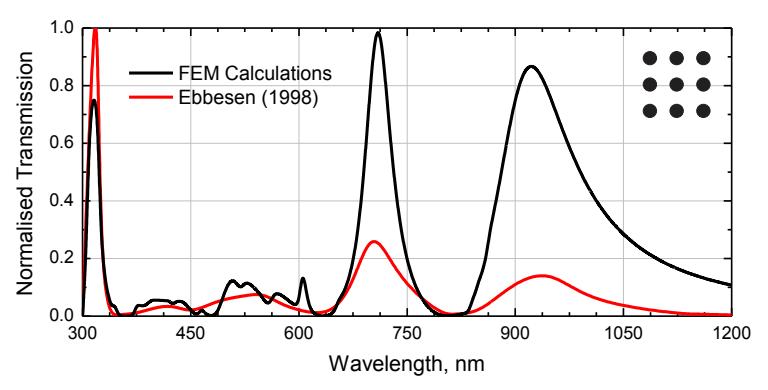
Results are comparable to the experimental data from various publications as a clear spectral line identity can be notified (Fig. 1). Basing on this, we can state that COMSOL Multiphysics program package can be successfully used for the modelling of light propagation through periodic sub-wavelength apertures. Current results will be used for the micromachining of real periodic subwavelength apertures.