
Ultrasmall photoluminescent gold nanoclusters (Au NCs), composed of several atoms with sizes up to a few nanometers have recently stimulated extensive interest. Unique molecule-like behaviors and facile synthesis make Au NCs very promising photoluminescent probes. However, possible application of Au NCs in biomedical area holds a potential risks related to exposure of biomolecules, cells and tissues. In this report we present effect of size and coating of photoluminescent Au NCs on cellular uptake, cytotoxicity and induction of reactive oxygen species (ROS) generation in cancer cells.
Two types of Au NCs that differ in coating were investigated: 2-(N-morpholino) ethanesulfonic acid (MES)-coated gold (Au-MES) NCs and bovine serum albumin (BSA)-encapsulated gold (BSA-Au) NCs. Au-MES NCs were synthesized according to the modified protocol by Bao et al. [1] and BSA-Au NCs were synthesized according to previously reported procedure with slight modifications [2]. The in vitro experiments were performed on MCF-7 breast cancer cells and more resistant MDA-MB-231 cells. After 24 hours of incubation BSA-Au NCs were observed accumulated in vesicles distributed mainly at the perinuclear region of cells indicating endocytic uptake. In contrast, Au-MES NCs were distributed homogeneously in total volume of the MCF-7 and MDA-MB-231 cells including nuclei as if they have entered the cells by diffusion. The XTT assay have shown that Au-MES NCs induced incubation-time dependent toxic effect on MCF-7 and MDA-MB-231 cells, 24 hour treatment was critical for cells viability. On the contrary, BSA-Au NCs demonstrated no significant influence on viability of both cell lines. To investigate whether the cytotoxicity is related to increased ROS generation due to the treatment with Au NCs flow cytometry was used. It was observed that Au-MES NCs induce oxidative stress by generating ROS, while after treatment with BSA-Au NCs no increase in ROS production within the cells was determined.
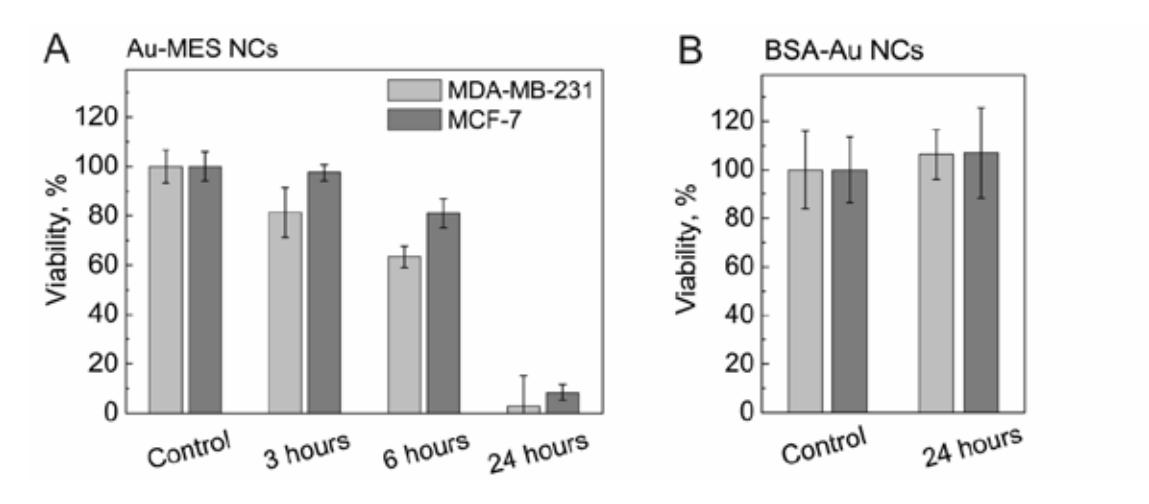
Incubation with Au-MES NCs increased levels of cell ROS generation resulting in increased cytotoxicity, however, it may not be the only reason as the ultrasmall size of Au-MES NCs [3] gives them a possibility to interact with DNA or other vital cellular components while BSA-coating ensured biocompatibility and low cytotoxicity of BSA-Au NCs.