
Atmospheric carbonaceous aerosols constitute a significant part of the atmospheric aerosols, while a large part of them consists of organic material (~50%). The carbonaceous atmospheric particulate matter consists of black carbon and a variety of organic compounds. Black carbon (BC) is a primary incomplete combustion-generated carbonaceous aerosol with a graphitic-like structure, while organic carbon (OC) may have both primary and secondary origins. Primary OC may result from fossil fuel emissions, biomass burning or represent biological particles or plant debris while the secondary OC can be formed in the atmosphere by gas-to-particle conversion.
Both organic carbon and black carbon mass concentrations were measured in Lithuania at coastal/marine (Preila), rural (Rūgšteliškis), and urban background (Vilnius) environments have been analyzed to infer the spatial and temporal distributions of the OC/BC ratios from May 2013 to October 2014. OC/BC ratios reflected the location of the different sites, as well as possible different sources influencing air quality. The estimations of OC/BC ratios were made to compare values of parameter $α$. In this study, parameter $α$ (Fig.1) was determined by coefficient of linear OC/BC fitting curve.
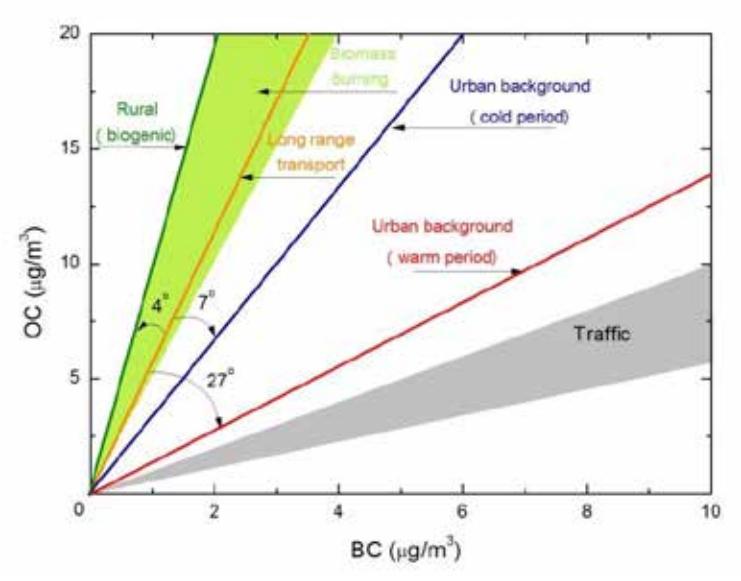
The highest hourly BC aerosol mass concentration in urban background environment reached 17.2 μg·m-3 during the cold period, while the mean BC concentration was found to be 2.34 μg·m-3, which is about a factor of three higher than mean values in coastal/marine and rural sites (0.84 and 0.77 μg·m-3, respectively). It was estimated that the mean OC concentrations have distinct seasonal variations with the highest values observed (8.60 μg·m-3) in urban background and lowest mean concentration (3.01 μg·m-3) in coastal/marine environment in the cold period. The maximum OC concentrations values during the cold period (75.44 μg·m-3) were more than four times higher of those in the warm period (17.78 μg·m-3) in urban background environment. In contrast, the mean OC values measured during the warm period in coastal/marine (4.11 μg·m-3) and rural (4.56 μg·m-3) environment was higher compared to the cold period (3.01 and 3.45 μg·m-3, respectively). Strong influence of local sources of BC in urban environment and long-range transport in rural environments was observed. The carbonaceous aerosol shows a relative enrichment in OC during the warm period in coastal/marine and rural sites ($α = 84°–85°$). The high values of OC/BC ratio in forested (rural) areas suggest that OC emissions could be derived from biogenic sources. The decrease of the OC/BC ratio in urban environment during the warm period was caused by the vehicle traffic activity and other anthropogenic sources.