Strong interest in laser sources based on low-cost organic semiconductors is provoked by their attractive electronic and optical properties combined with the mechanical flexibility and ease of processability [1-2]. Broad gain spectra offer wide emission-wavelength tunability across the entire visible range, whereas negligible temperature dependence of amplified emission threshold, output power and emission wavelength renders organic laser sources relevant for applications in spectroscopy as well as optical data communications, memory, sensing and displays [2]. Up to now, optically pumped lasers based on conjugated organic materials have been demonstrated in both solutions and thin films. With continuous efforts in pursuing electrically pumped organic lasing, organic semiconductors with improved stability, emissive as well as charge transport properties are constantly desired. Most of these properties are retained in organic crystals in which small size conjugated molecules are held together with long-range order via weak non-bonding interactions, such as van der Waals forces [3]. Moreover, in the last decade, organic crystals have played an important role in the development of organic solid state lasers.
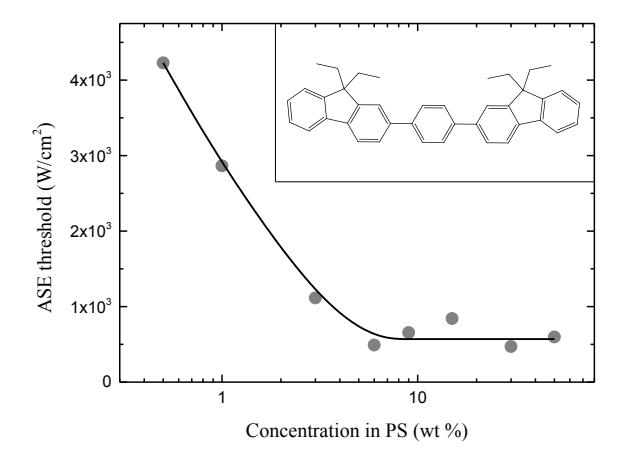
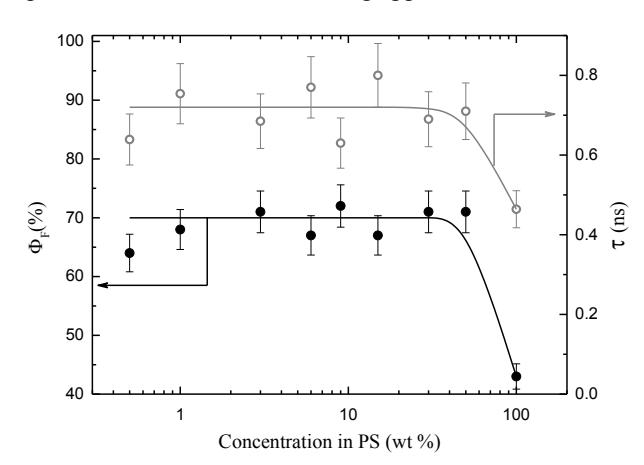
In this work, light amplification properties of new bifluorene compound, shown in the inset of Fig. 1, were investigated. The properties were assessed for the compound dispersed in polystyrene (PS) matrix as well as for single crystals, which were grown from supersaturated chlorobenzene/water solution. Emission measurements of the bifluorene compound dispersed in PS matrix at different concentrations (0.5-100 wt%) indicated weak concentration quenching. In particular, fluorescence quantum yield (${\Phi}_{F}$) and fluorescence lifetime (${\tau}$) remained almost unchanged up to 50 wt% of compound in PS (see Fig. 2). Bifluorene crystals exhibited similar fluorescence lifetime (~0.7 ns) and radiative relaxation rate (~100 s-1) values as compared to those estimated for compounds in PS matrix. Concentration dependence of amplified spontaneous emission (ASE) threshold ($I_{s}$) for studied molecules in PS matrix was investigated to reveal optimal conditions for laser operation. The lowest $I_{s}$ (580 W/cm2) was obtained for 6 wt% PS film. $I_{s}$ remained unchanged by further increasing chromophore concentration (see Fig. 1). However, $I_{s}$ in the compound crystal was couple orders of magnitude higher (67 kW/cm2) mainly because of absorption losses in thick bifluorene crystals. Importantly, ASE threshold values achieved in PS matrix were similar or even lower as compared to the most of reported results and showed great potential for bifluorene compound as active media for lasing applications.