
$K_2Bi_{1-x}Sm_x(PO_4)(MoO_4)$ powder samples were prepared by conventional high temperature solid-state reaction. The stoichiometric amounts ($Bi_2O_3$, $Sm_2O_3$, $MoO_3$, $K_2CO_3$ and $NH_4H_2PO_4$) were mixed in the mortar employing acetone as grinding media. The obtained powder was transferred to the porcelain crucible and annealed at 600 °C for 12 h in air. The calcination procedure was repeated another two times. [1]
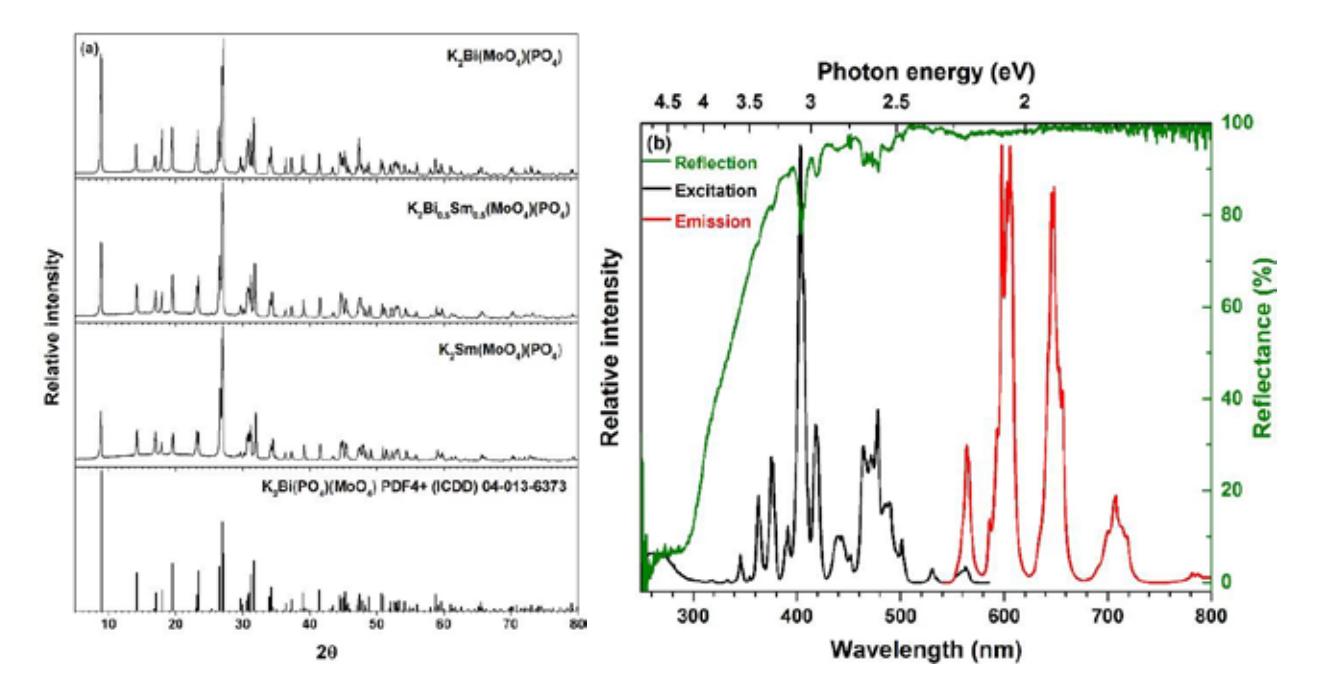
The structural, morphological and optical characteristics of the compounds were investigated by powder scanning X-ray diffraction (XRD), electron microscope (SEM) analysis and UV-Visible spectroscopy. The phase purity was confirmed by powder XRD measurements (Fig. 1a.). Isostructural compounds of K2Bi(PO4)(MoO4):Sm3+ are obtained at any Bi3+/Sm3+ ratio what is in line with the Vegard's law.
The reflection, excitation and emission spectra of the single phase compounds were measured and analyzed (Fig. 1b). The temperature dependent emission spectra and decay curves in 77 – 500 K temperature interval were also recorded and discussed.
Moreover, colour points, luminous efficacies (LE) and decay times were also calculated. The external quantum efficiency of the synthesized phosphors was calculated employing Eq. (1):
$$QE = \frac{\int I_{em,sample} - \int I_{em,BaSO_4}}{\int I_{abs,BaSO_4} - \int I_{abs,sample}} \times 100\%\tag{1}$$Samples were red emitting and showed moderate quantum efficiencies.