Biosensors are relatively cheap and reliable devices capable to resolve a large number of analytical problems in clinical diagnostic, environmental and industrial fields. The biosensor response is determined by the catalytical substrate conversion to a reaction product. In a case of amperometric biosensors the response is a result of the oksidation-reduction reaction on a surface of electrode. The concentration of the analyte is usually proportional to the measured current and can be determined by the calibration curve. In the simplest Michaelis-Menten scheme the substrates are directly converted to the products. In a more complex synergistic scheme, an enzyme catalyzes the parallel conversion of substrates into the products, with the concomitant cross reactions of the substrates and the products [1].
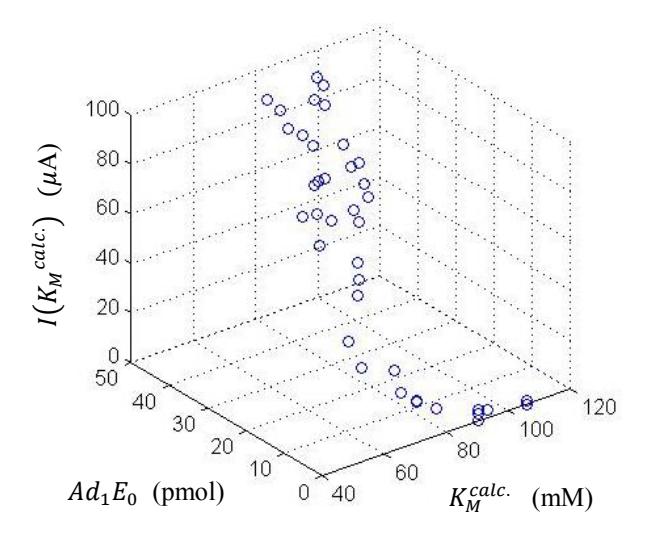
A biosensor must meet user requirements for a range of the analyte concentrations - $K_{calc.}$, a level of the saturation current - $I(K_{m}^{calc.})$ and an enzyme amount - $Ad_{1}E_{0}$. The measurement range and saturation current should be high enough, while the enzyme amount should be low as enzyme usually is expensive. The biosensor utilizing synergistic substrates conversion involves multiple changeable parameters: the thicknesses of enzyme and dialysis membranes, the concentrations of the enzyme and two reaction mediators [1]. By varying these parameters multicriteria Pareto optimal solutions can be achieved. A digital model based on a mathematical model of the biosensor facilitate this. It has been used to fine-tune the analytical characteristics of the biosensors. An optimisation algorithm uses the Chebyshev scalarization technique to transform a multicriteria problem into the single criteria optimisation problem [2]. The Hooke-Jeeves single criteria optimisation algorithm was used due to fast convergence like gradient descent algorithms and it requires no gradient of the optimised function [3]. The achieved Pareto optimal results are depicted in Fig. 1 and can be used by experts in a design phase of a practical biosensor utilizing synergistic substrates conversion.