
SAM on gold, resulting from the binding of thiols, are well-known examples of organized monolayers which enable one to functionalize surfaces and bind receptors in a controlled manner [1]. Sum frequency generation vibrational spectroscopy (SFG-VS) is powerful and versatile method for in-situ investigation of surfaces and interfaces. SFG was used to study self-assembled monolayers formed from 1-alkanethiols at Au surface. The resonant enhancement provides spectral information on surface characteristic vibrational transitions [2]. The results of the structural changes of MOPHE (N-(2-phenylethyl)-8-sulphanyloctanamide) (Fig. 1.) are presented and discussed. Data from the high-frequency spectral region, where C-H stretching vibrations take place, are discussed in this work.
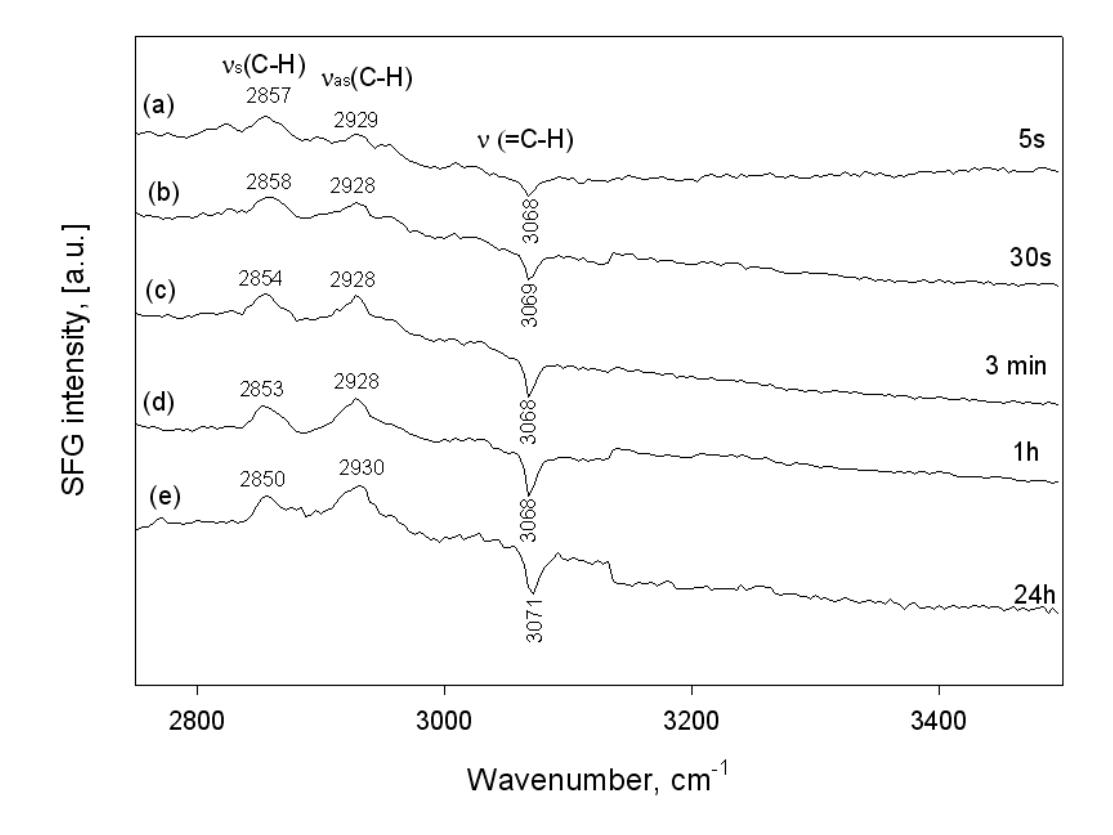
MOPHE (N-(2-phenylethyl)-8-sulphanyloctanamide) monolayer on Au surfaces probed by SFG shows hydrocarbon chain gauche defects, which are characterized by the clearly observed band near 2850 due to the symmetric stretching vibration of methylene groups. An another band located at 2930 cm-1 corresponds to assymetric stretching vibration of CH2. SFG spectra indicates that hydrocarbon chain defects remain after 24h of adsorption. Strong resonance near 3069 cm-1 belongs to stretching vibration $v(=C-H)$ of phenyl ring. Intensity of this band rapidly increases after 30 s of adsorption indicating formation of well-orederded structure at interface.