
Carrier lifetime is one of the most sensitive parameters to defects formed in semiconductor materials and devices. Thus, contact-less examination of carrier recombination, trapping and thermal emission rates is a proper tool for evaluation of pristine material quality and for monitoring of the evolution of the radiation defects introduced during irradiation.
In this study, fluence dependent variations of carrier recombination and trapping lifetime have been examined by means of microwave probed photoconductivity (MW-PC) transients. The epitaxial layers of GaN grown by MOCVD technology on sapphire substrates, HVPE grown self-standing GaN samples as well as wafer pieces of bulk GaN fabricated by the ammono-thermal (AT) technology were investigated. These materials contained different density of threading dislocations, varied in the range from $10^4$ to $10^{11}$ cm-2. Also, the undoped pristine GaN material and samples containing intentionally introduced impurities of Fe3+ and Mn2+ were researched. These sets of samples were irradiated with different fluences, ranging $10^{11}$ - $5 \times 10^{16}$ cm-2 diapason, of penetrative (by using the samples of relevant thickness) protons of 1.7 MeV protons and reactor neutrons.
The excess carrier transients recorded by MW-PC technique exhibit a two-componential, non-exponential decay for the as-grown MOCVD GaN epitaxial material, as illustrated in Fig. 1a for VU sample. The very initial carrier decay MW-PC component (top-scale curve in Fig 1a) correlates with photoluminescence (PL) decay rate. The asymptotic MW-PC relaxation component, which covers a time scale from tens of ns to tens of ms, can be only fitted by a stretched-exponent approximation: $\exp[-(t/\tau_{se})^{\alpha}]$. An initial fast decay component is determined by the radiative and non-radiative recombination as well as carrier capture processes, and its partial amplitude decreases with irradiation exposure time. The long-tail component is also transformed with irradiation fluence, as can be deduced from Fig. 1a, causing changes of stretched-exponential fractional index $\alpha$. The long-tail component is ascribed to the excess carrier trapping processes at dislocations that comprise a disordered network within the epi-layer.
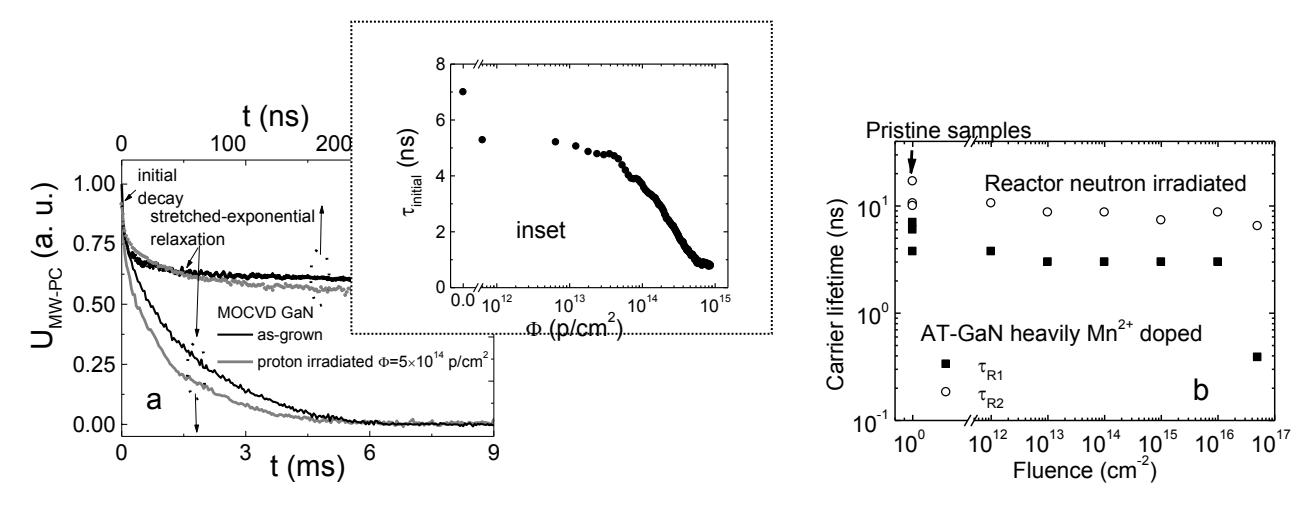
The lifetime, as an indicator of the concentration of the recombination centres, decreases non-linearly with proton fluence > $10^{14}$ p/cm2. This implies that the enhanced concentration of the fast radiation induced centres prevails within carrier decay processes in MOCVD GaN epi-layers, while trapping effect is less expressed. Large capture cross-sections (> $10^{-13}$ cm2) can be deduced from the short lifetime values obtained for MOCVD GaN. Lifetime variations in pristine AT-GaN samples indicate lateral inhomogeneity of dopant distribution. Two decay components ($\tau_{R1}$ and $\tau_{R2}$) imply two species of recombination centres ascribed to growth defects and to dopants. Nevertheless, the longer recombination lifetime values are obtained in bulk crystal AT-GaN samplers relative to dislocations-rich MOCVD GaN. The AT-GaN is rather tolerant (the clear decrease of carrier lifetime is obtained only for fluences > $10^{16}$ n/cm2) to neutron irradiations, relative to the MOCVD and HVPE GaN samples. The role and transforms of different radiation and technological defects in fluence dependent carrier lifetime variations will be discussed.