
Higher acenes are highly demanded in field of organic electronics, due to their high hole drift-mobility properties. However, higher acenes suffer from at least few drawbacks, such as low solubility in organic solvents that aggravates processing via printing technologies, photodimerization and oxygen addition reactions that occur at ambient conditions and lead to degradation of materials. Few design strategies were successfully introduced to increase stability of these molecules. First and the most successful of them, is replacement of some benzene rings with heterocyclic moieties, second, edge-cutting modification is non-linear arrangement of rings in the molecule. The introduction of heteroatoms to polyacene scaffold increases stability of the materials without loss or even with an increase of charge mobility [1]. Adjustment of aromatic ring annulation with introduction of heteroatoms has already showed some promising results [2]. Herein we present a novel V-shaped and two heteroatoms enriched heptacene analogs - 8H-16,17-epoxydinaphto[2,3-c:2',3'-g]carbazoles (EDNC), as potential materials for organic electronic devices. The results of investigation of their optical and photoelectric properties will be presented, as well.
Synthesis of EDNC derivatives was carried out using 2,7,9-trisubstituted carbazoles as initial materials. Few steps synthetic protocol allowed to introduce solubilizing side-substituents into 6, 8 and 10 positions of the molecule, reducing solubility issues of the materials to negligible levels. The synthesized EDNC derivatives are stable under ambient conditions in a solid state and solutions.
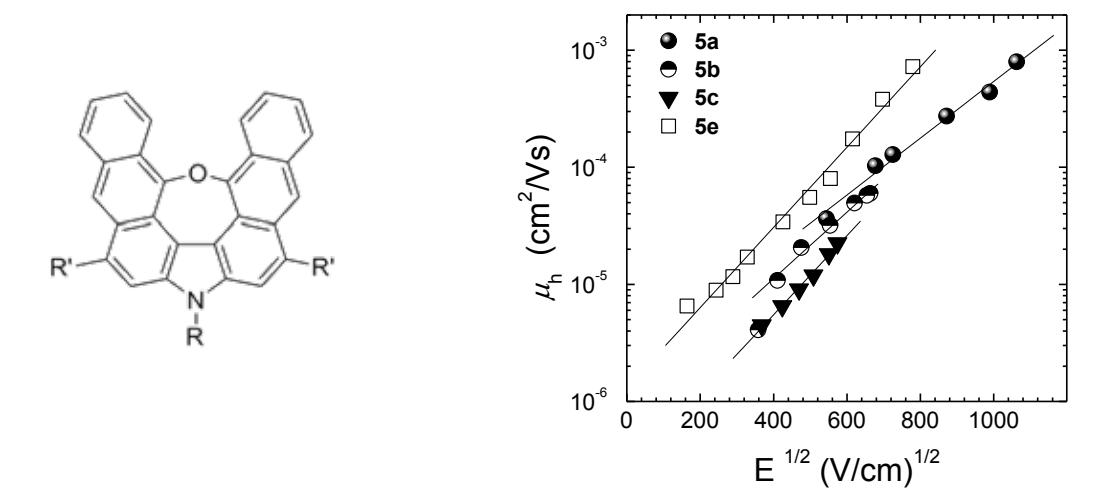
Optical properties of the synthesized compounds were assessed by absorption and fluorescence spectroscopy. Fluorescence spectra for most derivatives were observed at about 545 nm in solutions and in the range of 560 - 595 nm in solids. Hole drift-mobility of synthesized compounds was measured by XTOF method and reached up to $8 \cdot 10^{-4}$ cm2/(V s), which is enhanced for compounds possessing aryl side-substituents at 6 and 10 positions.