
Biotin labeling is widely used technique because of its extremely high affinity to avidin/streptavidin, promoting effective detection and purification by avidin/streptavidin conjugates [1,2]. Research applications include enzyme-linked immunosorbant assay (ELISA), immunoprecipitation (IP), cell surface labeling, flow cytometry and Western blot analysis. BirA, biotin ligase from E. coli, catalyzes the covalent attachment of biotin to the lysine side chain in a 15-mer peptide (Avi-tag), promoting targeted and highly efficient biotinylation.
The use of micro- or nanosized particles (ultrafine particles) in biochemistry and biotechnology became widespread, involving a large number of particle types and affinity mechanisms [3]. Applications include different kinds of isolation and purification of biomolecules and some solid phase applications. Sometimes, affine bound to particle biomolecule can undergo conformational changes and exhibit altered properties. Direct biotinylation of immobilized on particle molecule may benefit from this interaction, moreover this approach can help to streamline process of bio-orthogonal conjugation.
BirA was expressed in a form of fusion with MBP (maltose binding protein) involving consequent release of soluble BirA with TEV (tobacco etch virus) protease. This approach allowed to obtain 10 mg of recombinant BirA per liter of bacterial culture.
Peptide substrate for BirA (sequence: ENLYFQSHHHHHHHHHHGLNDIFEAQKIEWHE) contained Avi-tag, decahistidine tag and recognition site for TEV protease and has a mass 4081 Da. Peptide was bound to Millipore PureProteome Ni2+ coated magnetic beads, which are designed for affinity purification of His-tagged fusion proteins.
Activity test was carried out in following conditions: 40mM substrate, 10 mM Tris-HCl pH 8.0, 10 mM MgSO4, 10 mM ATP, 50μM D-biotin and 5μg BirA at 4°C for 16h. Then substrate on beads was washed twice by PBS and eluted by 500mM imidazole. Eluate was purified on Agilent SampliQ C18 Endcapped columns and analyzed on Bruker Microflex MALDI-TOF.
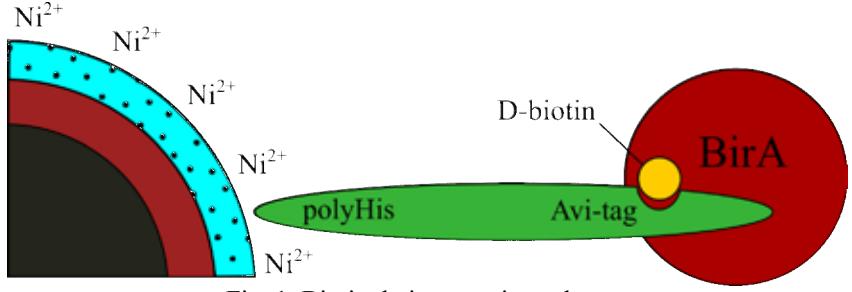
As a result we obtained nearly fully (>95%) biotinylated peptide with a mass 4307 Da. For comparison, the biotinylation reaction in solution proceeded less efficiently. This fact indicates that magnetic particles doesn't interfere with biotinylation reaction and, moreover, somehow improves the yield of biotinylated product.
Thus, we can suggest that this approach will be useful in applications such as bio-orthogonal conjugation, because it involves purification and biotinylation of the molecule of the interest at the same time.